Today's
EarthStation1.com 15% Off Commemorative Memorial Title: James
Stewart Biography, 2 Bonus Titles Jimmy Stewart MP4 Download DVD
Today, June 20, 2026
#JCKaelin here: MY day! (My wife amp;
family call me that name -- I amp; everyone else calls me #JC --
and so say my contracts! ; ) ========= June 20: International
Jimmy Day: -- Calling all Jimmys! This day is dedicated to all the
people who share this popular first name, which has been around
since the 13th century. The name "Jimmy" is derived from
the name "James" and is often associated with qualities
such as strength, loyalty, and kindness. Whether you know a Jimmy
or are one yourself, this is the perfect day to embrace your
unique identity and celebrate all that it stands for. So let's
raise a toast to all the Jimmys out there - may your day be filled
with love and appreciation! Jimmy is a male given name. It is
predominately used as a diminutive form of the given name James,
along with its short form, Jim. Both can also be used as the
adaptation into English of the modern Greek name Dimitris or the
older Dimitrios, especially amongst Greek immigrants in
English-speaking countries, due the similarity in the sound of the
short name "Dimi" and "Jimmy". The name Jimmy,
deriving from English, holds the significant meaning of
Supplanter. Its etymology traces back to the medieval English name
James, which originated from the Hebrew name Jacob. The name
Jacob, derived from the Hebrew word Yaaqov, carries the
connotation of one who supplants or replaces, and thereby the
successor of the one he supplants or replaces. Over time, the
diminutive form Jimmy emerged as a popular variant of the name
James and continues to be widely used to this day. Throughout
history, the name Jimmy has found its place in various contexts.
In literature, it appears in well-known works such as Robert Louis
Stevenson's Treasure Island, where Jimmy is a young protagonist
full of determination and wit. Additionally, the name Jimmy has
been associated with notable figures such as United States
President Jimmy Carter, tennis player Jimmy Connors, comedian and
talk show host Jimmy Fallon, and rock guitarist and songwriter
Jimmy Page. These instances in history reflect the versatility and
continued relevance of the name Jimmy. In modern usage, Jimmy
remains a widely recognized and cherished name. It is often used
as a given name, signifying strength and perseverance.
Furthermore, Jimmy is frequently used as a familiar and
affectionate nickname, denoting camaraderie and a sense of
intimacy. Whether as a first name or a nickname, the enduring
presence of the name Jimmy testifies to its rich historical roots
and enduring popularity in contemporary society. #JimmyDay #Jimmy
#InternationalDays On Sale @ 15% Off Discount Till Midnight PT!
https://store.earthstation1.com/james-stewart-biography-jimmy-stewart-dvd-mp4-us4.html
Today's
EarthStation1.com 15% Off Commemorative Memorial Title: The
Capitalist Cartoons Of John Sutherland MP4 Video Download DVD
Today, June 20, 2026
June 20: National Vanilla Milkshake Day:
-- Celebrates the iconic and timeless American cold beverage made
with vanilla ice cream, vanilla, and milk. The frosty vanilla
milkshake, known for its creamy texture and smooth flavor, has a
rich history dating back to the late 19th century when it showed
up in print for the first time in 1885. The original concoction
consisted of cream, eggs, and whiskey, resembling an adult
eggnog-type drink, and was often served with other alcoholic
tonics such as lemonades and soda waters. By the early 1900s, soda
fountains introduced sweeter, milk-based drinks that were more
kid-friendly without the whiskey ingredient. The modern milkshake
was introduced in 1922 Walgreens employee Ivar "Pop"
Coulson came up with an idea of adding 2 scoops of vanilla ice
cream to a malted milk recipe. An instant hit, the "Horlick's
Malted Milk" grew and by the 1950s, the vanilla milkshake
became a huge part of the American youth culture. The invention of
the blender by Stephen Poplawski helped popularize milkshakes by
making them easier to mix. Commercial milkshakes often include a
seaweed-based thickener to achieve the perfect texture. National
Vanilla Milkshake Day is a fun, nostalgic celebration that
highlights the enduring popularity of a simple yet beloved
beverage, inviting everyone to enjoy a sweet, creamy treat while
appreciating its history and cultural significance. ========= June
20: National Ice Cream Soda Day: -- Americans all over the country
enjoy their favorite dessert by trying out various flavors and
making it in different styles. With more than a century of
history, there is so much to learn about ice cream sodas, right
from how they were invented to the different methods of preparing
and consuming them in different states and cities of the U.S. As
with most inventions, ice cream soda was created unintentionally
by the coming together of ice cream and soda. It is believed that
Robert Green was trying to prepare chilled soda at a Philadelphia
fair but had run out of ice shavings. He came up with the idea of
adding ice cream to the soda to cool it. Thus, the ice cream soda
was born. Now, there are many different stories about the
invention of ice cream soda. Even though Robert Green loudly
claimed to be the inventor of the ice cream soda - and even had it
inscribed on his tombstone - another legend goes that it was Fred
Sanders who invented the delicious summer drink. Sanders ran a
confection shop and added ice cream to soda when he could not find
sweet cream. More people continued to claim credit for the
invention of the ice cream soda, especially because it was
marketed so well and hugely popular. George Guy and Philip Mohr
are two well-known claimants to the title of inventor of ice cream
soda. On Sale @ 15% Off Discount Till Midnight PT!
https://store.earthstation1.com/capitalist-cartoons-us-probusiness-propaganda-animation-dvd.html
Today's
EarthStation1.com 15% Off Commemorative Memorial Title: Outer
Space Films 4 Apollo 11 Live TV Coverage DVD, Download, USB
Today, June 20, 2026
June 20: National American Eagle Day: --
A celebration of the United States' national symbol as well as a
time to raise awareness about the bald eagle and to preserve the
bird's natural habitat. The holiday is meant to educate others
about the birds' importance, and to explore ways we can ensure
that the eagles continue to thrive for decades to come. In the
1950s, the bald eagle was at serious risk of becoming extinct.
Loss of their natural habitat, hunting, and the use of pesticides
that damaged their eggs made caused the population to massively
decline. The bird was classified as endangered in the U.S. in
1967. The bird went on to become a prime success story of the
Endangered Species Act. The bald eagle began to repopulate and
thrive, and in 1995, it was moved from the national endangered
species list to the national list of threatened species-a major
improvement! As of 2007, the bald eagle is no longer considered
threatened and has a healthy population level. National American
Eagle Day was launched by the American Eagle Foundation, a
Tennessee organization focused on protecting bald eagles and their
fellow birds of prey. Bald eagles like to live near large bodies
of water, as they mostly eat fish, and are known for their beauty
and grace when they soar through the air. They have been known as
treasured symbols of the United States since the 1700s. On Sale @
15% Off Discount Till Midnight PT!
https://store.earthstation1.com/outer-space-films-4-apollo-11-live-tv-coverage-2-dual-layer-4112.html
Today's
EarthStation1.com 15% Off Commemorative Memorial Title: Bizarre!
Blurs In The Line Between Fact & Fiction MP4 Download DVD Set
Today, June 20, 2026
June 20: Ugliest Dog Day: -- Celebrates
the pups out there with a face only a mother could love. But when
it comes to man's best friend, is there really any dog that can't
be deemed adorable? We honor the facially challenged ones on June
20, Ugliest Dog Day. What started as a fun contest has grown into
an annual celebration of the not-so-handsome dogs amongst us. So
grab your favorite pup and give him an extra snuggle today and as
you go about your day, say hi to every pup, pretty and not so
pretty. No matter how they look, the antics of furry animals will
always be undeniably cute. There are some really unphotogenic pets
out there, but hey, as they say, beauty is in the eye of the
beholder. This is why World's Ugliest Dog Day is celebrated on
June 20 every year. We love to love dogs every day, but dogs with
facial deformities or less attractive features are in the
spotlight today. Whether they lack fur or adorable faces, those
puppy eyes will always get us! The World's Ugliest Dog Contest is
an annual contest held in Petaluma, California, as part of the
Sonoma-Marin Fair, to decide which of the dogs entered in the
contest is the ugliest. The winner receives a trophy and the title
of 'The World's Ugliest Dog,' and the dog's owner receives $1,000
in prize money. Since 2017, the prize money has increased to
$1,600, along with a free trip to New York City. Throughout the
years, many dogs have participated to claim the esteemed title of
'The World's Ugliest Dog,' with one breed, in particular, winning
the most titles; the Chinese Crested. Since the inception of the
contest in the 1970s, the most unsightly dog has been from this
breed at least 22 times. With a hairless body and bulging eyes,
the breed is still beloved and described by the American Kennel
Club as an "ultra-affectionate companion dog." With
social media full of content featuring cute fluffy animals with
shares and likes stacked up, Ugliest Dog Days recognizes the
not-so-cute lot and makes owners beam with pride for their
unattractive pets. On Sale @ 15% Off Discount Till Midnight PT!
https://store.earthstation1.com/bizarre-blurs-in-the-line-between-fact-amp-fiction-dvd.html
Today's
EarthStation1.com 15% Off Commemorative Memorial Title: The Kosovo
War JPG Photo & MPG Video Collection CD Download
Today, June 20, 2026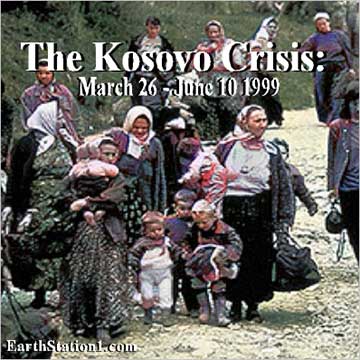
June 20: World Refugee Day: -- The United
Nations General Assembly launched this holiday in 2000, and since
then, the worldwide community has spent the day focused on ways to
improve the lives of refugees. Most of us know that refugees are
forced to leave their homes due to war, terror, or other
crises-but fleeing their home country is often just the beginning
of a difficult journey. Many refugees find themselves living in
camps until they are resettled-some of which are dangerous or not
well-equipped for long term living. Refugees don't always have a
say in which country they are ultimately relocated to, and the
bureaucratic process involved in finding their new home can take
years. Worldwide refugee crises have taken center stage in the
news in recent years, so it's more important than ever to share
support and to celebrate World Refugee Day. Can you imagine what
it would be like to have to leave your home, your community, your
country and flee to another? Can you picture the challenges you
would face and the sense of loss you would feel? Well, every
minute 20 people undergo this harrowing experience and become
refugees. Perhaps you are even a refugee yourself or know of
displaced people living in your community. In a world where
violence, persecution and war force thousands of people to flee
each day, it's important that we all come together in support of
refugees, and what better way than on World Refugee Day? This
special occasion aims to raise awareness of and empathy for what
displaced people go through, as well as celebrate refugees all
over the world. On Sale @ 15% Off Discount Till Midnight PT!
https://store.earthstation1.com/the-kosovo-crisis-march-26--june-10-1999-photo-cd-m26101999.html
Today's
EarthStation1.com 15% Off Commemorative Memorial Title: Attila The
Hun 2 Part Documentary Series DVD MP4 Video Download
Today, June 20, 2026
June 20, 451 AD: The Huns: The Hunnic
Invasions: The Hunnic Invasion Of Gaul: The Battle Of The
Catalaunian Plains: -- In the Champagne-Ardenne region of Roman
Gaul (modern France), a coalition led by the Roman general Flavius
Aetius and by the Visigothic king Theodoric I engage in battle
against the Huns and their vassals commanded by their king Attila
The Hun. Also called the Battle Of The Catalaunian Fields, Battle
Of The Campus Mauriacus, Battle Of Chalons, Battle Of Troyes and
Battle Of Maurica, the Battle Of The Catalaunian Plains proved one
of the last major military operations of the Western Roman Empire,
although Germanic foederati composed the majority of the coalition
army. Whether the battle was strategically conclusive remains
disputed: the Romans possibly stopped the Huns' attempt to
establish vassals in Roman Gaul. However, the Huns successfully
looted and pillaged much of Gaul and crippled the military
capacity of the Romans and Visigoths. Attila died only two years
later in 453, and after the Battle of Nedao (454) a coalition of
the Huns' Germanic vassals dismantled his Hunnic Empire. On Sale @
15% Off Discount Till Midnight PT!
https://store.earthstation1.com/attila-the-hun-2-part-documentary-series-dvd-mp4-video-downlo24.html
Today's
EarthStation1.com 15% Off Commemorative Memorial Title: Japan: A
Cherry Blossom By Many Other Names MP4 Video Download DVD
Today, June 20, 2026
June 20, 1180: The History Of Japan: The
Heian Period (794-1185): The Minamoto-Taira Clan Disputes: The
Genpei War (Japanese: Genpei Kassen, Genpei-Gassen [The Jisho-Juei
War (Japanese: Jisho-Juei No Ran)]) (1180-1185): The Battle Of Uji
(1180) (The First Battle Of Uji): -- The Genpei War, a national
civil war between the Taira and Minamoto clans, begins with The
Battle Of Uji just outside Kyoto, starting a five-year-long war,
concluding with a decisive Minamoto victory in the naval Battle of
Dan-no-ura five years later. In early 1180, Prince Mochihito, the
Minamoto Clan's favored claimant to the Imperial Throne, was
chased by Taira forces to the Mii-dera, a temple just outside
Kyoto. Due to the interference of a Mii-dera monk with Taira
sympathies, the Minamoto army arrived too late to help defend the
temple. Minamoto no Yorimasa and Prince Mochihito, along with a
force of about fifteen hundred men including the warrior monks of
Mii-dera and the Watanabe clan, fled south towards Nara. They
crossed the Uji River, just outside the Byodo-in, and tore up the
planks of the bridge behind them to prevent the Taira from
following. Three warrior monks in particular are named in the
Heike Monogatari: Gochi-in no Tajima, Tsutsui Jomyo Meishu, and
Ichirai Hoshi. These three, along with the other monks of
Mii-dera, fought with bow and arrow, a variety of swords, daggers
and naginata. A contingent of the Taira troops was led by Ashikaga
Tadatsuna, one of the few warriors of direct Minamoto descent who
stayed loyal to his oath to the Taira family up until he and his
father were murdered by one of their retainers, Kiryu Rokuro.
According to Azuma Kagami, the 18-year-old Tadatsuna is supposedly
remembered as having had the strength of one hundred men, a voice
that echoed over 10 li (5 km), and teeth of 1 sun (3.03 cm) long.
Kagami further stated that "there will be no warrior in
future ages like this Tadatsuna." Led by their young general,
the Taira force forded the river and caught up with the Minamoto.
Tadatsuna was the first warrior on the frontline and following a
custom of the period is said to have proclaimed his name and
lineage before charging his enemies. Yorimasa tried to help the
Imperial Prince get away, but was struck with an arrow in the
right elbow. While his sons, Nakatsuna and Kanetsuna were fighting
to fend off their enemies, Yorimasa committed seppuku. And it is
said that "Yorimasa committed seppuku in a way that was to
set the standard for generations to come." Prince Mochihito
was captured and killed at Komyozen torii shortly after the battle
by the Taira clan. The name "Genpei" (sometimes
romanized as Gempei) comes from alternate readings of the kanji
"Minamoto" (Gen) and "Taira" (Hei, pronounced
as the second element in some compounds as :ei). The conflict is
also known in Japanese as The Jisho-Juei War (Japanese: Jisho-Juei
no Ran), after the two Imperial eras between which it took place.
The term Genpei Kassen is sometimes used in Japan, but it has been
argued that it is not appropriate to use the term "Genpei"
for this war. The Genpei War followed a coup d'etat by the Taira
in 1179 with the removal of rivals from all government posts, and
subsequently banishing them, and a call to arms against the Taira,
led by the Minamoto in 1180. On April 25, 1185 The Battle Of
Dan-No-Ura (Japanese: Dan-No-Ura No Tatakai) ended the war, a
major sea battle at Dan-No-Ura (modern Shimonoseki) in the
Shimonoseki Strait off the southern tip of the main Japanese
island of Honshu. On that date (or on March 24, 1185 by the
official web page of Shimonoseki City), the fleet of the Minamoto
Clan (Genji), led by Minamoto No Yoshitsune, defeated the fleet of
the Taira clan (Heike). The morning rip tide was an advantage for
the Taira, but turned to their disadvantage in the afternoon. The
young Emperor Antoku was one of those who died among the Taira
nobles. The battle resulted in the downfall of the Taira and the
establishment of Japan's first shogunate, the Kamakura shogunate,
under Minamoto No Yoritomo, who appointed himself as Shogun in
1192, governing Japan as a military dictator from the eastern city
of Kamakura; the battle also established the supremacy of the
samurai caste in Japanese sosciety for the next seven hundred
years -- however, it has been pointed out that the Battle of Oshu
in 1189 was the last battle during this period of civil war, as it
completed Yoritomo's nationwide domination through the annexation
of Northeast Japan. On Sale @ 15% Off Discount Till Midnight PT!
https://store.earthstation1.com/japan-a-cherry-blossom-by-many-other-names-mp4-video-download-dvd.html
Today's
EarthStation1.com 15% Off Commemorative Memorial Title: Pirates 12
Part Documentary Series MP4 Video Download DVD
Today, June 20, 2026
June 20, 1631: Crime: Organized Crime:
Piracy: The Barbary Pirates (The Barbary Corsairs, The Ottoman
Corsairs): Slave Raids: Barbary Slave Raids: The Sack Of
Baltimore: -- The remote Irish village of Baltimore in West Cork,
Ireland is attacked by Algerian pirates from the Barbary Coast of
North Africa - Dutchmen, Algerians, and Ottoman Turks. The attack
was the largest by Barbary slave traders on Ireland. The attack
was led by a Dutch captain, Jan Janszoon van Haarlem, also known
as Murad Reis the Younger, who was enslaved by Algerians but
released when he renounced his faith. Murad's force was led to the
village by a man called Hackett, the captain of a fishing boat he
had captured earlier, in exchange for his freedom. Hackett was
subsequently hanged from the clifftop outside the village for
conspiracy. Murad's crew, made up of Algerians, captured 107
villagers, mostly English settlers along with some local Irish
people (some reports put the number as high as 237). The attack
was focused on the area of the village known to this day as the
Cove. The villagers were put in irons and taken to a life of
slavery in Algiers. Some prisoners were destined to live out their
days as galley slaves, rowing for decades without ever setting
foot on shore while others would spend long years in harem or as
labourers. At most three of them ever returned to Ireland. One was
ransomed almost at once and two others in 1646. In the aftermath
of the raid, the remaining villagers moved to Skibbereen, and
Baltimore was virtually deserted for generations. In his book The
Stolen Village, Des Ekin alleges that Sir Walter Coppinger, a
prominent Catholic lawyer of Hiberno-Norse descent and member of
the leading Cork family, who had become the main landowner in the
area after the death of Sir Thomas Crooke, 1st Baronet, the
founder of the English colony, secretly hired the Barbary pirates
to attack the village in a conspiracy with the family of deceased
local Irish clan chief, Sir Fineen O'Driscoll. It was the Clan
O'Driscoll who had rented Baltimore and it's lucrative pilchard
fishing grounds to English Puritan settlers. Following the
construction of a local fortress to protect the village, however,
the Baltimore Puritan settlers had ceased paying black rent to Sir
Fineen and his heirs. Ekin accordingly accuses Sir Fineen
O'Driscoll's exiled derbhfine (a term for patrilineal groups and
power structures defined in the first written tracts in early
Irish law) in Spain after the 1601 Battle of Kinsale, who
allegedly would have felt insulted by the stoppage of the rent
payments from Baltimore, but could not retaliate by legal means,
of hiring Murad Rais at Coppinger's urging. On the other hand,
Murad may just as easily have planned the raid without any help.
For example, it is well-documented that the authorities had
advanced intelligence that Murad planned to make an attack against
a port town along the County Cork coast, although Kinsale was
incorrectly thought to be the target rather than Baltimore. On
Sale @ 15% Off Discount Till Midnight PT!
https://store.earthstation1.com/pirates-12-part-documentary-series-mp4-video-download-124.html
Today's
EarthStation1.com 15% Off Commemorative Memorial Title: The French
Revolution Series + Irish Rebellion & You Are There MP4 DVD
Today, June 20, 2026
June 20, 1789: The Age Of Enlightenment
(The Enlightenment, The Age Of Reason): The Age Of Revolution: The
Atlantic Revolutions: The Ancien Regime (French: The Old Regime):
The Estates Of The Realm (The Three Estates): The Third Estate
(Commoners): The French Revolution: The National Assembly (French:
Assemblee Nationale): The Tennis Court Oath (French: Serment Du
Jeu De Paume): -- In a pivotal event in the French Revolution,
deputies of the French Third Estate, who had begun to call
themselves the National Assembly, took the Tennis Court Oath
(French: Serment du Jeu de Paume), vowing "not to separate,
and to reassemble wherever circumstances require, until the
constitution of the kingdom is established". The
Estates-General had been called to address the country's fiscal
and agricultural crisis, but immediately after convening in May
1789, they had become bogged down in issues of
representation-particularly, whether they would vote by head
(which would increase the power of the Third Estate, as they
outnumbered the other two estates hugely) or by order. On 17 June,
the Third Estate, led by the comte de Mirabeau, began to call
themselves the National Assembly. On the morning of 20 June, the
deputies were shocked to discover that the chamber door was locked
and guarded by soldiers. Immediately fearing the worst and anxious
that a royal attack by King Louis XVI was imminent, the deputies
congregated in a nearby indoor jeu de paume court in the
Saint-Louis district of the city of Versailles, near the Palace of
Versailles. There, 576 of the 577 members from the Third Estate
took a collective oath "not to separate, and to reassemble
wherever circumstances require, until the constitution of the
kingdom is established". The only person who did not join was
Joseph Martin-Dauch from Castelnaudary, who would only execute
decisions made by the king. On Sale @ 15% Off Discount Till
Midnight PT!
https://store.earthstation1.com/the-french-revolution-dvd-3-part-tv-documentary-serie3.html
Today's
EarthStation1.com 15% Off Commemorative Memorial Title: The
Monarchy: British Royal Family History TV Series DVD MP4 USB Drive
Today, June 20, 2026
June 20, 1837: Royal Accessions:
Alexandrina Victoria Hanover succeeds to the British throne as
Queen Victoria, Queen Of The United Kingdom Of Great Britain And
Ireland upon the death of her uncle, William IV, reigning until
her death 64 years later, the longest reign in British history
until that time, a time that later became known as The Victorian
Era of British history; on May 1, 1876, Victoria adopted the
additional title of Empress of India. ========= William IV, King
Of The United Kingdom Of Great Britain And Ireland, King Of
Hanover from June 26, 1830 until his death. nicknamed "The
Sailor King" (b. August 21, 1765) was born William Henry
Hanover in the early hours of the morning at Buckingham House
(modern Buckingham Palace), the third child and son of King George
III and Queen Charlotte. He had two elder brothers, George, Prince
of Wales, and Prince Frederick (later Duke of York and Albany) and
was not expected to inherit the Crown. William succeeded his elder
brother George IV, becoming the last king and penultimate monarch
of Britain's House Of Hanover. William served in the Royal Navy in
his youth, spending time in British North America and the
Caribbean,. In 1789, he was created Duke Of Clarence and St
Andrews. Between 1791 and 1811, he cohabited with the courtesan
actress Dorothea Jordan, with whom he had ten children, all of
whom took the surname FitzClarence. In 1818, he married Princess
Adelaide of Saxe-Meiningen. William remained faithful to Adelaide
during their marriage. In 1827, he was appointed Britain's first
Lord High Admiral since 1709. As his two elder brothers died
without leaving legitimate issue, William inherited the throne
when he was 64 years old. His reign saw several reforms: the Poor
Law was updated, child labour restricted, slavery abolished in
nearly all of the British Empire, and the electoral system
refashioned by the Reform Acts of 1832. Although William did not
engage in politics as much as his brother or his father, he was
the last British monarch to appoint a prime minister contrary to
the will of Parliament. He granted his German kingdom a
short-lived liberal constitution. William had no surviving
legitimate children at the time of his death, so he was succeeded
by his niece Victoria in the United Kingdom and his brother Ernest
Augustus in Hanover. Both Kine William and Queen Adelaide were
fond of their niece, Princess Alexandrina Victoria Of Kent, the
future Queen Victoria. Their attempts to forge a close
relationship with the girl were frustrated by the conflict between
the King and Victoria's widowed mother, the Duchess Of Kent And
Strathearn. The King, angered at what he took to be disrespect
from the Duchess to his wife, took the opportunity at what proved
to be his final birthday banquet in August 1836 to settle the
score. Speaking to those assembled at the banquet, who included
the Duchess and Princess Victoria, William expressed his hope that
he would survive until Victoria was 18 so that her mother the
Duchess would never be regent. He said, "I trust to God that
my life may be spared for nine months longer ... I should then
have the satisfaction of leaving the exercise of the Royal
authority to the personal authority of that young lady, heiress
presumptive to the Crown, and not in the hands of a person now
near me, who is surrounded by evil advisers and is herself
incompetent to act with propriety in the situation in which she
would be placed." The speech was so shocking that Victoria
burst into tears, while her mother sat in silence and was only
with difficulty persuaded not to leave immediately after dinner
(the two left the next day). William's outburst undoubtedly
contributed to Victoria's tempered view of him as "a good old
man, though eccentric and singular". William survived, though
mortally ill, to the month after Victoria's coming of age. "Poor
old man!", Victoria wrote as he was dying, "I feel sorry
for him; he was always personally kind to me." William was
"very much shaken and affected" by the death of his
eldest daughter, Sophia, Lady de L'Isle and Dudley, in childbirth
in April 1837. Queen Adelaide attended the dying William
devotedly, not going to bed herself for more than ten days.
William died in the early hours of the morning at Windsor Castle,
aged 71 where he was buried in the Royal Vault at St George's
Chapel. ========= Queen Victoria was born Alexandrina Victoria
Hanover on May 24, 1819 at Kensington Palace, London, England, the
daughter of Prince Edward, Duke of Kent and Strathearn, the fourth
son of King George III. Both the Duke of Kent and King George III
died in 1820, and Victoria was raised under close supervision by
her German-born mother, Princess Victoria of Saxe-Coburg-Saalfeld.
She inherited the throne at the age of 18, after her father's
three elder brothers had all died, leaving no surviving legitimate
children. The United Kingdom was already an established
constitutional monarchy, in which the sovereign held relatively
little direct political power. Privately, Victoria attempted to
influence government policy and ministerial appointments;
publicly, she became a national icon who was identified with
strict standards of personal morality. Victoria married her first
cousin, Prince Albert of Saxe-Coburg and Gotha, in 1840. Their
nine children married into royal and noble families across the
continent, tying them together and earning her the sobriquet "the
grandmother of Europe". After Albert's death in 1861,
Victoria plunged into deep mourning and avoided public
appearances. As a result of her seclusion, republicanism
temporarily gained strength, but in the latter half of her reign
her popularity recovered. Her Golden and Diamond Jubilees were
times of public celebration. Her reign of 63 years and seven
months was longer than that of any of her predecessors, and is
known as the Victorian era. It was a period of industrial,
cultural, political, scientific, and military change within the
United Kingdom, and was marked by a great expansion of the British
Empire. She was the last British monarch of the House Of Hanover.
Her son and successor, Edward VII, initiated the House of
Saxe-Coburg and Gotha, the line of his father. Queen Victoria died
at half past six in the evening of January 22, 1901 at the age of
81 at Osborne House, Isle of Wight, England. Her son Albert Edward
Saxe-Coburg-Gotha succeeded her upon her death, initiating the
House of Saxe-Coburg and Gotha, the line of his father, and the
beginning of what became known as The Edwardian Era of British
history. The State Funeral Of Queen Victoria of February 2, 1901,
held in St George's Chapel, Windsor Castle after an enormous
funeral procession, was one of the largest and most significant
gatherings of European royalty ever to occur. On Sale @ 15% Off
Discount Till Midnight PT!
https://store.earthstation1.com/the-monarchy-3-part-british-royal-family-tv-series-dvd-mp4-u34.html
Today's
EarthStation1.com 15% Off Commemorative Memorial Title: Remember
When: It'll Never Fly w/ Dick Cavett Inventions DVD, MP4, USB
Today, June 20, 2026
June 20, 1840: Great Inventions: The
Industrial Revolution: The First Industrial Revolution (1760 - c.
1840): Telecommunications: Telegraphy: -- Samuel Morse receives
the patent for his electrical telegraph, the point-to-point text
messaging system primarily used from the 1840s until the late 20th
century. It was the first electrical telecommunications system,
and the most widely used of a number of early messaging systems
called telegraphs, that were devised to communicate text messages
quicker than physical transportation. Electrical telegraphy can be
considered to be the first example of electrical engineering. Text
telegraphy consisted of two or more geographically separated
stations, called telegraph offices. The offices were connected by
wires, usually supported overhead on utility poles. Many different
electrical telegraph systems were invented, but the ones that
became widespread fit into two broad categories. The first
category consists of needle telegraphs in which a needle pointer
is made to move electromagnetically with an electric current sent
down the telegraph line. Early systems used multiple needles
requiring multiple wires. The first commercial system, and the
most widely used needle telegraph, was the Cooke and Wheatstone
telegraph, invented in 1837. The second category consists of
armature systems in which the current activates a telegraph
sounder which makes a click. The archetype of this category was
the Morse system, invented by Samuel Morse in 1838. On May 24,
1844, Samuel Morse sent the message "What hath God wrought"
(a biblical quotation, Numbers 23:23) from the Old Supreme Court
Chamber in the United States Capitol to his assistant, Alfred
Vail, in Baltimore, Maryland, to inaugurate the first telegraph
line. In 1865, the Morse system became the standard for
international communication using a modified code developed for
German railways. Electrical telegraphs were used by the emerging
railway companies to develop train control systems, minimizing the
chances of trains colliding with each other. This was built around
the signalling block system with signal boxes along the line
communicating with their neighbouring boxes by telegraphic
sounding of single-stroke bells and three-position needle
telegraph instruments. In the 1840s, the electrical telegraph
superseded optical telegraph systems, becoming the standard way to
send urgent messages. By the latter half of the century, most
developed nations had created commercial telegraph networks with
local telegraph offices in most cities and towns, allowing the
public to send messages called telegrams addressed to any person
in the country, for a fee. Beginning in 1850, submarine telegraph
cables allowed for the first rapid communication between
continents. Electrical telegraph networks permitted people and
commerce to transmit messages across both continents and oceans
almost instantly, with widespread social and economic impacts.
Circa 1894, the electric telegraph led to Guglielmo Marconi's
invention of wireless telegraphy, the first means of radiowave
telecommunication. In the early 20th century, manual telegraphy
was slowly replaced by teleprinter networks. Increasing use of the
telephone pushed telegraphy into a few specialist uses. Use by the
general public was mainly special occasion telegram greetings. The
rise of the Internet and usage of email in the 1990s largely put
an end to dedicated telegraphy networks. Telegraphy is the
long-distance transmission of messages where the sender uses
symbolic codes, known to the recipient, rather than a physical
exchange of an object bearing the message. Thus flag semaphore is
a method of telegraphy, whereas pigeon post is not. Ancient
signalling systems, although sometimes quite extensive and
sophisticated as in China, were generally not capable of
transmitting arbitrary text messages. Possible messages were fixed
and predetermined and such systems are thus not true telegraphs.
The earliest true telegraph put into widespread use was the
optical telegraph of Claude Chappe, invented in the late 18th
century. The system was used extensively in France, and European
nations occupied by France, during the Napoleonic era. The
electric telegraph started to replace the optical telegraph in the
mid-19th century. It was first taken up in Britain in the form of
the Cooke and Wheatstone telegraph, initially used mostly as an
aid to railway signalling. This was quickly followed by a
different system developed in the United States by Samuel Morse.
The electric telegraph was slower to develop in France due to the
established optical telegraph system, but an electrical telegraph
was put into use with a code compatible with the Chappe optical
telegraph. The Morse system was adopted as the international
standard in 1865, using a modified Morse code developed in Germany
in 1848. The heliograph is a telegraph system using reflected
sunlight for signalling. It was mainly used in areas where the
electrical telegraph had not been established and generally used
the same code. The most extensive heliograph network established
was in Arizona and New Mexico during the Apache Wars. The
heliograph was standard military equipment as late as World War
II. Wireless telegraphy developed in the early 20th century became
important for maritime use, and was a competitor to electrical
telegraphy using submarine telegraph cables in international
communications. Telegrams became a popular means of sending
messages once telegraph prices had fallen sufficiently. Traffic
became high enough to spur the development of automated
systems-teleprinters and punched tape transmission. These systems
led to new telegraph codes, starting with the Baudot code.
However, telegrams were never able to compete with the letter post
on price, and competition from the telephone, which removed their
speed advantage, drove the telegraph into decline from 1920
onwards. The few remaining telegraph applications were largely
taken over by alternatives on the internet towards the end of the
20th century. On Sale @ 15% Off Discount Till Midnight PT!
https://store.earthstation1.com/remember-when-it39ll-never-fly-dvd-technology-history-dick-cave39.html
Today's
EarthStation1.com 15% Off Commemorative Memorial Title: Suspense!
Old Time Radio Series DVD, MP3 Download, USB Flash Drive
Today, June 20, 2026
June 20, 1893: Crime: Crime In The United
States: Murders: Mass Murders: The Murders Of Abby And Andrew
Borden: -- Lizzie Borden is acquitted of the gruesome murders of
her father and stepmother. Lizzie Andrew Borden (July 19, 1860 -
June 1, 1927) was an American woman tried and acquitted of the
August 4, 1892, axe murders of her father and stepmother in Fall
River, Massachusetts. No one else was charged in the murders, and
despite ostracism from other residents, Borden spent the remainder
of her life in Fall River. She died of pneumonia at age 66, just
days before the death of her older sister, Emma. The Borden
murders and trial received widespread publicity throughout the
United States, and along with Borden herself, they remain a topic
in American popular culture to the present day. They have been
depicted in numerous films, theatrical productions, literary
works, and folk rhymes and are still very well-known in the Fall
River area. The case was memorialized in a popular skipping-rope
rhyme, sung to the tune of the then-popular song "Ta-ra-ra
Boom-de-ay": "Lizzie Borden took an axe | and gave her
mother forty whacks. | When she saw what she had done | she gave
her father forty-one." In reality, Borden's stepmother
suffered 18 or 19 blows; her father suffered 11 blows. On Sale @
15% Off Discount Till Midnight PT!
https://store.earthstation1.com/suspense-mp3-dvd-complete-old-time-radio-serie3.html
Today's
EarthStation1.com 15% Off Commemorative Memorial Title: The
Twentieth Century With Walter Cronkite TV Series 10 MP4s / 10 DVDs
Today, June 20, 2026
June 20, 1899: #BOTD: #HBD! Jean Moulin,
French civil servant, prefect in Aveyron (1937-1939) and
Eure-et-Loir (1939-1940) and hero of the French Resistance who
succeeded in unifying the main networks of the Resistance in World
War II, a unique act in Europe, first President of the National
Council Of The Resistance from May 23, 1943 until his death less
than two months later at the hands of the Gestapo, one of the main
heroes of the French Resistance, unifying it under Charles de
Gaulle (d. July 8, 1943) is #born Jean Pierre Moulin at 6 Rue
d'Alsace in Beziers, Herault, son of Antoine-Emile Moulin and
Blanche Elisabeth Pegue. He was the grandson of an insurgent
opposing the coup d'etat of 2 December 1851. His father was a lay
teacher at the Universite Populaire and a Freemason at the lodge
Action Sociale. Moulin was baptised on 6 August 1899 in the church
of Saint-Vincentin in Saint-Andiol (Bouches-du-Rhone), the village
his parents came from. He spent an uneventful childhood in the
company of his brother, Joseph, and his sister, Laure. Joseph died
of acute peritonitis in 1907. Throughout his early years, Moulin
was an average student, including at the Lycee Henri IV in
Beziers. One of his report cards states that "he would be an
excellent student, if he were ever to start working." In
1917, he enrolled at the Faculty of Law of Montpellier, where he
was not a brilliant student though he did finish his legal studies
with a diploma. However, thanks to the influence of his father, he
was appointed as attache to the cabinet of the prefect of Herault
under the presidency of Raymond Poincare. Moulin was mobilised on
April 17, 1918 as part of the age class of 1919, the last class to
be mobilised in France. He was assigned to the 2nd Engineer
Regiment of Montpellier. At the beginning of September, after an
accelerated training, he headed with his regiment to the front in
the Vosges, where he was posted in the village of Socourt. His
regiment was preparing to go to the front lines as part of the
attack planned by Foch for November13, but the Armistice was
signed on November 11. Although Moulin did not fight directly on
the front lines, he was nevertheless in a position to observe the
horrors of war. He saw its aftermath on the battle fields and the
devastation of villages. He helped to bury the war dead in the
region around Metz. He wrote home expressing his shock at seeing
the starved state of British prisoners of war who had just been
freed. Nevertheless, nothing in the documented history of Jean
Moulin's experience during World War I hinted at what his role
would be during World War II. While still enlisted after the War,
he was posted successively to Seine-et-Oise, Verdun and
Chalon-sur-Saone. He worked as a carpenter, a digger and later a
telephonist for the 7th and 9th Engineer Regiments. He was
de-mobilised in November and, on November 4, 1919, resumed his
post as attache at the prefecture of Herault, in Montpellier.
After World War I, Moulin resumed his studies of law. His position
as attache at the prefecture of Herault allowed him to finance his
university studies while also providing a useful apprenticeship in
politics and government. He obtained his law degree in July 1921
He then entered the prefectural administration as chief of staff
to the deputy of Savoie in 1922 and then sous-prefet of
Albertville from 1925 to 1930. Moulin was appointed sous-prefet of
Chateaulin, Brittany in 1930. At the same time, he published
political cartoons in the newspaper Le Rire under the pseudonym
Romanin. He also illustrated books by the Breton poet Tristan
Corbiere, including an etching for La Pastorale de Conlie,
Corbiere's poem about Camp Conlie where many Boon soldiers died in
1870 during the Franco-Prussian War. He also made friends with the
Breton poets Saint-Pol-Roux in Camaret and Max Jacob in Quimper.
In 1932, Pierre Cot, a Radical-Socialist politician, named Moulin
his second in command or chef adjoint when he was serving as
Foreign Minister under Paul Doumer's presidency. In 1933, Moulin
was appointed sous-prefet of Thonon-les-Bains, parallel to his
function of head of Cot's cabinet in the Air Ministry under
President Albert Lebrun. On January 19, 1934, Moulin was appointed
sous-prefet of Montargis, but he did not assume the office and
chose to remain under Cot. In the first half of April, Moulin was
appointed to the Seine prefecture and, on July 1, he took his
place as secretary general in Somme, in Amiens. In 1936, he was
once more named chief of cabinet of Cot's Air Ministry of the
Popular Front. In that capacity, Moulin was involved in Cot's
efforts to assist the Second Spanish Republic by sending it planes
and pilots. For the Istres-Damas-Le Bourget race, he presented the
winners with their prize; Benito Mussolini's son was one of those
winners. He became France's youngest prefet in the Aveyron
departement, based in the commune of Rodez, in January 1937. It
has been claimed that during the Spanish Civil War, Moulin
assisted with the shipment of arms from the Soviet Union to Spain.
A more commonly accepted version of events is that he used his
position in the French air ministry to deliver planes to the
Spanish Republican forces. In January 1939, Moulin was appointed
prefect of the Eure-et-Loir department, based in Chartres. After
war against Germany was declared, he asked multiple times to be
demoted because "[his] place is not at the rear, at the head
of a rural departement". Against the advice of the Minister
of the Interior, he asked to be transferred to the military school
of Issy-Les-Moulineaux, near Paris. The minister forced him to
return to Chartres, where the War quickly made its way to him in
the form of German air strikes and columns of distressed and
sometimes wounded refugees. As the Germans approached Chartres, he
wrote to his parents, "If the Germans - who are capable of
anything - make me say dishonorable words, you already know, it is
not the truth". In mid-June, German troops entered Chartres.
Moulin was arrested by the Germans on June 17, 1940 because he
refused to sign a false declaration that three Senegalese
tirailleurs had committed atrocities, killing civilians in La
Taye. In fact, those civilians had been killed by German bombings.
Beaten and imprisoned because he refused to comply, Moulin
attempted suicide by cutting his own throat with a piece of broken
glass. This act left him with a scar he would often hide with a
scarf, giving us the image of Jean Moulin by which he often is
remembered today. The suicide attempt did not succeed because he
was discovered by a guard and taken to a hospital for treatment.
Because he was a Radical, he was dismissed by the Vichy regime,
led by Marshal Philippe Petain on November 2, 1940, along with
other left-wing prefets. He then began writing his diary, First
Battle, in which he relates his resistance against the Nazis in
Chartres, which was later published at the Liberation and prefaced
by de Gaulle. Having decided not to collaborate, Moulin left
Chartres for his parents' home town, Saint-Andiol,
Bouches-du-Rhone, and joined the French Resistance, specifically,
the organisation Free France. Under the name Joseph Jean Mercier,
he went to Marseille, where he met other resistants, including
Henri Frenay and Antoine Sachs. Moulin travelled to London in
September 1941 after passing through Spain and Portugal. He was
received on October 24 by Charles de Gaulle, who wrote about
Moulin, "A great man. Great in every way". Moulin
summarised the state of the French Resistance to de Gaulle. Part
of the Resistance considered him too ambitious, but de Gaulle had
confidence in his network and skills. He gave Moulin the
assignment of co-ordinating and unifying the various Resistance
groups, a difficult mission that would take time and effort to
accomplish. On January 1, 1942, Moulin parachuted into the
Alpilles and met with the leaders of the resistance groups. Jean
Moulin died under uncertain circumstances and conflicting reports
as to when and where he died. A death certificate filed by the
Paris Chef of Police indicates he died near or in the train
station of Metz, Occupied France, possibly while being transported
by train to Germany, after he had been captured, brutally tortured
and beaten into a coma by the infamous war criminal Klaus Barbie,
SS and Gestapo officer known as the "Butcher of Lyon".
Moulin's death was registered at Metz railway station. Other
documents place his death in Frankfurt, Germany. From wherever
location he did in fact die, his body was supposedly sent to
Paris, where it was cremated at the Pere Lachaise Cemetery, where
it was stored in a numbered urn. These ashes were later
transferred to the Pantheon on December 19, 1964. The speech given
at the transfer site by Andre Malraux, a writer and cabinet
minister, is one of the most famous speeches in French history.
According to witnesses, Moulin and his men had their fingernails
removed using hot needles as spatulas. In addition, his fingers
were placed in the door frame of the interrogation cell, with the
door then repeatedly closed until his knuckles were shattered.
They increasingly tightened his handcuffs until they penetrated
the skin, breaking the bones in his wrists. He was beaten until
his face was unrecognizable and he fell into a coma. Moulin's arms
and legs were broken, as were most of his ribs. After the torture
sessions, Barbie ordered that Moulin be displayed as an object
lesson to other imprisoned members of the Resistance. The last
time he was seen alive he was still in a coma, his head swollen
and yellow from bruising and wrapped in bandages, according to the
description given by Christian Pineau, fellow prisoner and member
of the Resistance. Barbie was awarded the Iron Cross (First Class)
by Adolf Hitler for his campaign against the French Resistance and
the capture of Moulin. After the war, United States intelligence
services employed him for his anti-communist efforts and aided his
escape to Bolivia, where he advised the dictatorial regime on how
to repress opposition through torture. In 1983, the United States
apologised to France for the U.S. Counterintelligence Corps
helping him escape to Bolivia, aiding Barbie's escape from an
outstanding arrest warrant. In 1972, it was discovered he was in
Bolivia. While in Bolivia, the West German Intelligence Service
recruited him. Barbie is suspected of having had a role in the
Bolivian coup d'etat orchestrated by Luis Garcia Meza in 1980.
After the fall of the dictatorship, Barbie lost the protection of
the government in La Paz. In 1983, he was arrested and extradited
to France, where he was convicted of crimes against humanity and
sentenced to life in prison. Although he had been sentenced to
death in absentia twice earlier, in 1947 and 1954, capital
punishment had been abolished in France in 1981. Barbie died of
cancer in 1991, at age 77, in his Lyon prison. #JeanMoulin
#FrenchResistance #Partisans #ResistanceDuringWWII
#FrenchNationalHeroes #FranceWorldWarII #FranceWWII
#FranceDuringWorldWarII #FranceDuringWWII #KlausBarbie #Gestapo
#MP4 #VideoDownload #DVD On Sale @ 15% Off Discount Till Midnight
PT!
https://store.earthstation1.com/the-twentieth-century-with-walter-cronkite-5-dual-layer-dvd5.html
Today's
EarthStation1.com 15% Off Commemorative Memorial Title: The Genius
That Was China Documentary Series DVD, Download, USB Drive
Today, June 20, 2026
June 20, 1900: The Century Of Humiliation
(The Hundred Years Of National Humiliation): The Qing Dynasty: The
Boxer Rebellion (1899-1901) (The Boxer Uprising, The Boxer
Insurrection, The Yihetuan Movement): The Siege Of The
International Legations: -- The Imperial Chinese Army begins a
55-day siege of the Legation Quarter in Beijing, China. Two days
prior, Empress Dowager Cixi of China ordered all foreigners
killed, including foreign diplomats and their families. The Boxer
Rebellion, also known as the Boxer Uprising or Yihetuan Movement,
was a violent anti-foreign, anti-colonial and anti-Christian
uprising that took place in China between 1899 and 1901, toward
the end of the Qing dynasty. It was initiated by the Militia
United in Righteousness (Yihetuan), known in English as the
"Boxers", for many of their members had been
practitioners of Chinese martial arts, also referred to in the
west as "Chinese Boxing"; in modern parlance, the
uprising could be called "The Martial Artist Rebellion"
or "The Martial Arts Rebellion". They were motivated by
proto-nationalist sentiments and by opposition to Western
colonialism and the Christian missionary activity that was
associated with it. The uprising took place against a background
that included severe drought and disruption caused by the growth
of foreign spheres of influence. After several months of growing
violence, in Shandong and the North China plain, against the both
foreign and Christian presence in June 1900, Boxer fighters,
convinced they were invulnerable to foreign weapons, converged on
Beijing with the slogan "Support the Qing government and
exterminate the foreigners." Foreigners and Chinese
Christians sought refuge in the Beijing Legation Quarter, where
900 soldiers, marines, and civilians, largely from Europe, Japan,
and the United States, and about 2,800 Chinese Christians took
refuge. On June 20, the Siege Of The International Legations began
in retaliation. In response to reports of an armed invasion to
lift the siege, the initially hesitant Empress Dowager Cixi
supported the Boxers, on June 18 ordered all foreigners killed in
accordance with the Boxer's wishes, and on June 21 issued an
Imperial Decree declaring war on the foreign powers. Diplomats,
foreign civilians and soldiers as well as Chinese Christians in
the Legation Quarter were detained for 55 days by the Imperial
Army of China and the Boxers, but the execution order was not
carried out. Chinese officialdom was split between those
supporting the Boxers and those favoring conciliation, led by
Prince Qing. The supreme commander of the Chinese forces, the
Manchu General Ronglu (Junglu), later demonstrated that he acted
to protect the besieged foreigners. Many other officials refused
the imperial order to fight against foreigners. General Ronglu
deliberately sabotaged the performance of the imperial army during
the rebellion. Han Chinese General Dong Fuxiang, whose Han Chinese
Muslim troops, the "Kansu Braves", were able and eager
to destroy the foreign military forces in the legations, were
stopped from doing so by General Ronglu. The Manchu prince Zaiyi,
one of the leaders of the Boxer Rebellion, was very xenophobic and
friendly with General Dong Fuxiang. Zaiyi wanted artillery for
Dong's troops to destroy the foreign legations. Ronglu blocked the
transfer of artillery to Zaiyi and Dong, preventing them from
destroying the legations. When artillery was finally supplied to
the imperial army and Boxers, it was only done so in limited
amounts; Ronglu deliberately held back the rest of them. The
Chinese forces defeated the small 2,000 person Western relief
force at the Battle of Langfang, but lost several decisive
battles, including the Battle of Beicang, and the entire imperial
court was forced to retreat as the forces of the Eight-Nation
Alliance invaded Beijing. Due to the fact that moderates at the
Qing imperial court tried to appease the foreigners by moving the
Muslim Kansu Braves out of their way, the allied army was able to
march into Beijing and seize the capital. The Eight-Nation
Alliance, after being initially turned back, brought 20,000 armed
troops to China, defeated the Imperial Army, and arrived at Peking
on August 14, relieving the siege of the Legations. Uncontrolled
plunder of the capital and the surrounding countryside ensued,
along with the summary execution of those suspected of being
Boxers. The Boxer Protocol of 7 September 1901 provided for the
execution of government officials who had supported the Boxers,
provisions for foreign troops to be stationed in Beijing, and 450
million taels of silver-approximately 10B USD at 2018 silver
prices and more than the government's annual tax revenue-to be
paid as indemnity over the course of the next thirty-nine years to
the eight nations involved. The Empress Dowager then sponsored a
set of institutional and fiscal changes in a failed attempt to
save the dynasty. On Sale @ 15% Off Discount Till Midnight PT!
https://store.earthstation1.com/the-genius-that-was-china-dvd-tv-documentary-series-2-disc-se2.html
Today's
EarthStation1.com 15% Off Commemorative Memorial Title: The
Spanish Earth 1937 + Bonus For Whom The Bell Tolls DVD, MP4, USB
Today, June 20, 2026
June 20, 1905: #BOTD: #HBD! Lillian
Hellman, American playwright, author, and screenwriter known for
her success on Broadway, as well as her communist sympathies and
political activism (d. June 30, 1984) is #born Lillian Florence
Hellman in New Orleans, Louisiana to a Jewish family. She was
blacklisted after her appearance before the House Committee on
Un-American Activities (HUAC) at the height of the anti-communist
campaigns of 1947-1952. Although she continued to work on Broadway
in the 1950s, her blacklisting by the American film industry
caused a drop in her income. Many praised Hellman for refusing to
answer questions by HUAC, but others believed, despite her denial,
that she had belonged to the Communist Party. In December 1936,
her play Days to Come closed its Broadway run after just seven
performances. In it, she portrayed a labor dispute in a small Ohio
town during which the characters try to balance the competing
claims of owners and workers, both represented as valid. Communist
publications denounced her failure to take sides. That same month
she joined several other literary figures, including Dorothy
Parker and Archibald MacLeish, in forming and funding Contemporary
Historians, Inc., to back a film project, The Spanish Earth, to
demonstrate support for the anti-Franco forces in the Spanish
Civil War. In October 1937, Hellman spent a few weeks in Spain to
lend her support, as other writers had, to the International
Brigades of non-Spaniards who had joined the anti-Franco side in
the Spanish Civil War. As bombs fell on Madrid, she broadcast a
report to the U.S. on Madrid Radio. In 1989, journalist and Ernest
Hemingway's third wife, Martha Gellhorn, herself in Spain at that
period, disputed the account of this trip in Hellman's memoirs and
claimed that Hellman waited until all the witnesses were dead
before describing events that never occurred. Nevertheless,
Hellman had documented her trip in the New Republic in April 1938
as "A Day in Spain." Langston Hughes wrote admiringly of
the radio broadcast in 1956. As a playwright, Hellman had many
successes on Broadway, including Watch on the Rhine, The Autumn
Garden, Toys in the Attic, Another Part of the Forest, The
Children's Hour and The Little Foxes. She adapted her
semi-autobiographical play The Little Foxes into a screenplay,
which starred Bette Davis. Hellman became the first female
screenwriter to receive an individual Academy Award nomination for
Best Adapted Screenplay in 1943. Hellman was romantically involved
with fellow writer and political activist Dashiell Hammett, author
of the classic detective novels The Maltese Falcon and The Thin
Man, who also was blacklisted for 10 years until his death in
1961. The couple never married. Beginning in the late 1960s, and
continuing through to her death, Hellman turned to writing a
series of popular memoirs of her colorful life and acquaintances.
Hellman's accuracy was challenged in 1979 on The Dick Cavett Show,
when Mary McCarthy said of her memoirs that "every word she
writes is a lie, including 'and' and 'the'." Hellman brought
a defamation suit against McCarthy and Cavett, and during the
suit, investigators found errors in Hellman's Pentimento. They
said that the "Julia" section of Pentimento, which had
been the basis for the Oscar-winning 1977 movie of the same name,
was actually based on the life of Muriel Gardiner. Martha
Gellhorn, one of the most prominent war correspondents of the
twentieth century, as well as Ernest Hemingway's third wife, said
that Hellman's remembrances of Hemingway and the Spanish Civil War
were wrong. McCarthy, Gellhorn and others accused Hellman of lying
about her membership in the Communist Party and of being an
unrepentant Stalinist. The defamation suit was unresolved at the
time of Hellman's death in 1984; her executors eventually withdrew
the complaint. Hellman's modern-day literary reputation rests
largely on the plays and screenplays from the first three decades
of her career, and not on the memoirs published later in her life.
Lillian Hellman died aged 79 from a heart attack near her home on
Martha's Vineyard, Massachusetts, and is buried beneath a pine
tree on a rise at one end of Abels Hill/Chilmark Cemetery,
Chilmark, Martha's Vineyard. On Sale @ 15% Off Discount Till
Midnight PT!
https://store.earthstation1.com/the-spanish-earth-dvd-1937-spanish-civil-war-ernest-hemin1937.html
Today's
EarthStation1.com 15% Off Commemorative Memorial Title: Errol
Flynn Golden Age Of Television TV Shows DVD, Download, USB Drive
Today, June 20, 2026
June 20, 1909: #BOTD: Errol Flynn,
Australian-American actor, satyr, singer and producer who achieved
during the Golden Age of Hollywood after 1935 (d. October 14,
1959) is #born Errol Leslie Thomson Flynn at Queen Alexandra
Hospital in Battery Point, Tasmania, Australia. Considered the
natural successor to Douglas Fairbanks, Errol Leslie Thomson Flynn
achieved worldwide fame for his romantic swashbuckler roles in
Hollywood films, as well as frequent partnerships with Olivia de
Havilland. He was best known for his role as the eponymous hero in
The Adventures of Robin Hood (1938); his portrayal of the
character was named by the American Film Institute as the
18th-greatest hero in American film history. His other famous
roles included the lead in Captain Blood (1935), Major Geoffrey
Vickers in The Charge of the Light Brigade (1936), as well as the
hero in a number of Westerns, such as Dodge City (1939), Santa Fe
Trail (1940) and San Antonio (1945). Flynn also stirred
controversy for his reputation as a womaniser and hedonistic
personal life. He became a US citizen in 1942. Errol Flynn died in
Vancouver, British Columbia, Canada of myocardial infarction due
to coronary thrombosis and coronary atherosclerosis, with fatty
degeneration of liver and portal cirrhosis of the liver
significant enough to be listed as contributing factors, aged 50.
He is buried at Forest Lawn Memorial Park in Glendale, Los Angeles
County, California. #ErrolFlynn #Actors #Singers #Producers
#MovieStars #FilmStars #MatineeIdols #LeadingMen #Movies #Film
#MotionPictures #Hollywood #ClassicalHollywoodCinema
#ClassicalHollywoodNarrative #ClassicHollywoodCinema
#GoldenAgeOfHollywood #OldHollywood #SilverScreen #AmericanCinema
#CinemaOfTheUS #ActionHeroes #MovieStars #FilmStars #PopIcons
#CulturalIcons #MP4 #VideoDownload #DVD On Sale @ 15% Off Discount
Till Midnight PT!
https://store.earthstation1.com/errol-flynn-golden-age-of-television-dvd.html
Today's
EarthStation1.com 15% Off Commemorative Memorial Title: The
Idolmaker (1980) DVD, MP4 Video Download, USB Flash Drive
Today, June 20, 2026
June 20, 1931: #BOTD: #HBD! Olympia
Dukakis, American actress who has performed in more than 130 stage
productions, more than 60 films and in 50 television series (d.
May 1, 2021) is #born in Lowell, Massachusetts into a Greek
immigrant family. Best known as a screen actress, she started her
career in theater. Not long after her arrival in New York City,
she won an Obie Award for Best Actress in 1963 for her
off-Broadway performance in Bertolt Brecht's Man Equals Man. She
later moved to film acting and won an Academy Award and a Golden
Globe, among other accolades, for her performance in Moonstruck
(1987). She received another Golden Globe nomination for Sinatra
(1992) and Emmy Award nominations for Lucky Day (1991), More Tales
of the City (1998) and Joan of Arc (1999). Dukakis's
autobiography, Ask Me Again Tomorrow: A Life in Progress, was
published in 2003. In 2018, a feature-length documentary about her
life, titled Olympia, was released theatrically in the United
States. Olympia Dukakis died after a period of ill health under
hospice care of undetermined precise causes at her home in
Manhattan on May 1, 2021, at the age of 89. She is buried at Mount
Hebron Cemetery in Montclair, New Jersey. On Sale @ 15% Off
Discount Till Midnight PT!
https://store.earthstation1.com/the-idolmaker-bob-marcucci-biography-dvd.html
Today's
EarthStation1.com 15% Off Commemorative Memorial Title: TV Music &
Dance Shows #14 Aretha Temptations Kinks DVD MP4 USB Drive
Today, June 20, 2026
June 20, 1936: #BOTD: #HBD! Billy Guy,
African American singer, best known as a lead singer for the
Coasters, singing lead on such hits as "Searchin'",
"Little Egypt", "Run Red Run", "Wait A
Minute", among others (d. November 5, 2002) is #born Frank
Phillips in Itasca, Texas. Songwriters Jerry Leiber and Mike
Stoller, who wrote for The Coasters, praised his "marvelous
sense of comedy and timing." Before Guy joined The Coasters
in 1955, he was part of a comedy singing duo called "Bip and
Bop". One single, "Ding Dong Ding", b/w
"Du-Wada-Du", was released on Aladdin Records in 1955.
He made a number of solo records during the 1960s and 1970s. He
was inducted into the Rock and Roll Hall of Fame in 1987. Billy
Guy died in Clark County, Nevada, of cardiovascular disease, aged
66. He is buried at Woodlawn Cemetery in Las Vegas, Nevada. On
Sale @ 15% Off Discount Till Midnight PT!
https://store.earthstation1.com/classic-tv-music-amp-dance-shows-14-aretha-temptations-kinks-d14.html
Today's
EarthStation1.com 15% Off Commemorative Memorial Title: Props And
Jets: Messerschmitt Me 163 Komet Rocket Plane DVD, MP4, USB
Today, June 20, 2026
June 20, 1938: Aviation: The History Of
Aviation: The History Of Military Aviation: Maiden Flights: --
First flight of the first rocket powered aircraft, the Heinkel He
176, flown by Erich Warsitz, who also flew the Heinkel He 178, the
world' first practical jet aircraft on August 27, 1939. It was the
world's first aircraft to be propelled solely by a liquid-fuelled
rocket. It was a private venture by the Heinkel company in
accordance with director Ernst Heinkel's emphasis on developing
technology for high-speed flight. The performance of the He 176
was not spectacular, but it did provide "proof of concept"
for rocket propulsion. All documents regarding the He 176 were
destroyed during the war. The often quoted performance data of the
aircraft, such as a speed reaching 750 km/h, as well as some of
the drawings, have been called into question. Only two true
pictures of the He 176 have survived which were probably taken in
Peenemunde during tests. On Sale @ 15% Off Discount Till Midnight
PT!
https://store.earthstation1.com/props-and-jets-messerschmitt-me-163-komet-rocket-plane-163.html
Today's
EarthStation1.com 15% Off Commemorative Memorial Title: The Golden
Age Of Rock 'N' Roll DVD, MP4 Video Download, Flash Drive
Today, June 20, 2026
June 20, 1938: #BOTD: #HBD! Mickie Most,
English music producer with a string of hit singles with acts such
as The Animals, Herman' Hermits, The Nashville Teens, Donovan,
Lulu, Suzi Quatro, Hot Chocolate, Arrows, Racey, and The Jeff Beck
Group, often issued on his own RAK Records label (d. May 30, 2003)
is #born Michael Peter Hayes in Aldershot, Hampshire, England. One
of the best examples of Mickie Most's production genius is
"Sunshine Superman", a single written and recorded by
Donovan that John Bush in The Allmusic Guide To Rock described as
"[one of the] classics of the era," and "the
quintessential bright summer sing along". "Sunshine
Superman" reached the top of the Billboard Hot 100 in the
United States, and subsequently became the title track of
Donovan's third album, Sunshine Superman. Chart positions were No.
1 (US, released July 1966), and No. 2 (UK) (UK, released December
1966). It was Donovan's only single to reach No. 1 on Billboard's
Hot 100. It was the first product from the highly successful
three-year collaboration between Donovan and producer Mickie Most,
and is generally considered to be one of the first examples of the
musical genre that came to be known as psychedelia. The song
features styles of psychedelic pop, folk rock, psychedelic folk,
and psychedelic rock. Jimmy Page and John Paul Jones, later of Led
Zeppelin, play on the recording. Mickie Most died at his London,
England home aged 64 from possibly peritoneal mesothelioma, a
complication of asbestosis. The investigative journalist Paul Foot
thought it was probable that he contracted the cancer from
ingesting fibres from vinyl tiles impregnated with asbestos,
intended to improve soundproofing in recording studios. His
remains were cremated, and the ashes given to his widow Christina.
A blue plaque, to commemorate his life, donated by the Heritage
Foundation/Musical Heritage, was unveiled at RAK Studios on May
16, 2004, with his wife and his two daughters Cristalle and
Nathalie in attendance. The lunch and auction that followed raised
40K PS for research into mesothelioma. On Sale @ 15% Off Discount
Till Midnight PT!
https://store.earthstation1.com/the-golden-age-of-rock-39n39-roll-dvd-complete-tv-series-5-39395.html
Today's
EarthStation1.com 15% Off Commemorative Memorial Title: Benito
Mussolini Documentaries DVD, MP4 Video Download, USB Drive
Today, June 20, 2026
June 20, 1940: The European Civil War:
World War II: The Second European War (The European Theater Of
World War II): The Battle Of France (The Western Campaign [German:
Westfeldzug], The French Campaign [German: Frankreichfeldzug;
French: Campagne De France], The Fall Of France): The Italian
Invasion Of France (The Battle Of The Alps): -- Mussolini orders
that Italy immediately begin the unsuccessful invasion of France's
homeland. The Italian Invasion Of France was the first major
Italian engagement of World War II and the last major engagement
of the Battle Of France. On 19 June, Mussolini ordered his
generals to seek contact with the enemy, and at 2050 hours Italian
General Roatta sent a directive to "undertake small offensive
operations immediately [and t]o make contact with the enemy
everywhere, to decisively harass enemy forces as harshly as
possible." The main offensive was to begin "as soon as
possible [and] no later than 23 June". On the morning of 20
June, Mussolini told Badoglio to start the offensive immediately
by the next morning, stating "I do not want to suffer the
shame of the Germans occupying Nice and remitting it to us."
On Sale @ 15% Off Discount Till Midnight PT!
https://store.earthstation1.com/benito-mussolini-dvd-wwii-documentaries.html
Today's
EarthStation1.com 15% Off Commemorative Memorial Title: American
World War II Aviation Films DVD, MP4 Download, USB Drive
Today, June 20, 2026
June 20, 1941: Aviation: The History Of
Aviation: The History Of Military Aviation: The European Civil
War: World War II: The Second European War (The European Theater
Of World War II): Air Warfare Of World War II: United States Army
Air Forces: United States Army Air Forces Of World War II: The
United States Army Air Forces (USAAF, AAF): -- The United States
Army Air Corps is deprecated to being the American training and
logistics section of what is known until 1947 as the United States
Army Air Forces, just two days before Hitler's invasion of the
Soviet Union; it is the direct predecessor of the United States
Air Force (USAF), one of today's six armed forces of the United
States. The United States Army Air Forces (USAAF or AAF) was the
major land-based aerial warfare service component of the United
States Army and de facto aerial warfare service branch of the
United States during and immediately after World War II
(1941-1945). The AAF was a component of the United States Army,
which on March 2, 1942 was divided functionally by executive order
into three autonomous forces: 1) the Army Ground Forces; 2) the
United States Army Services of Supply (which in 1943 became the
Army Service Forces); and 3) the Army Air Forces. Each of these
forces had a commanding general who reported directly to the Army
Chief Of Staff. The AAF administered all parts of military
aviation formerly distributed among the Air Corps, General
Headquarters Air Force, and the ground forces' corps area
commanders, and thus became the first air organization of the U.S.
Army to control its own installations and support personnel. The
peak size of the AAF during the Second World War was over 2.4
million men and women in service and nearly 80,000 aircraft by
1944, and 783 domestic bases in December 1943. By "V-E Day",
the Army Air Forces had 1.25 million men stationed overseas and
operated from more than 1,600 airfields worldwide. The Army Air
Forces was created in June 1941 to provide the air arm a greater
autonomy in which to expand more efficiently, to provide a
structure for the additional command echelons required by a vastly
increased force, and to end an increasingly divisive
administrative battle within the Army over control of aviation
doctrine and organization that had been ongoing since the creation
of an aviation section within the U.S. Army Signal Corps in 1914.
The AAF succeeded both the Air Corps, which had been the statutory
military aviation branch since 1926, and the GHQ Air Force, which
had been activated in 1935 to quiet the demands of airmen for an
independent Air Force similar to the Royal Air Force which had
already been established in the United Kingdom. Although other
nations already had separate air forces independent of their army
or navy (such as the British Royal Air Force and the German
Luftwaffe), the AAF remained a part of the Army until a defense
reorganization in the post-war period resulted in the passage by
the United States Congress of the National Security Act Of 1947
with the creation of an independent United States Air Force in
September 1947. In its expansion and conduct of the war, the AAF
became more than just an arm of the greater organization. By the
end of World War II, the Army Air Forces had become virtually an
independent service. By regulation and executive order, it was a
subordinate agency of the United States Department of War (as were
the Army Ground Forces and the Army Service Forces) tasked only
with organizing, training, and equipping combat units, and limited
in responsibility to the continental United States. In reality,
Headquarters AAF controlled the conduct of all aspects of the air
war in every part of the world, determining air policy and issuing
orders without transmitting them through the Army Chief Of Staff.
This "contrast between theory and fact is... fundamental to
an understanding of the AAF." On Sale @ 15% Off Discount Till
Midnight PT!
https://store.earthstation1.com/wwii-aviation-films-second-world-war-aircraft-dual-layer-dvd.html
Today's
EarthStation1.com 15% Off Commemorative Memorial Title: TV Music &
Dance Shows #15 Ready Steady Go Vol II DVD MP4 Flash Drive
Today, June 20, 2026
June 20, 1942: #BOTD: #HBD! Brian Wilson,
American musician, singer, songwriter, record producer and genius
who co-founded the Beach Boys, one of the greatest and most
pioneering songwriters and record producers of the twentieth
century (d. June 11, 2025) is #born Brian Douglas Wilson at
Centinela Hospital Medical Center in Inglewood, California. After
signing with Capitol Records in 1962, Wilson wrote or co-wrote
more than two dozen Top 40 hits for the group. In addition to his
lifelong struggles with mental illness, Wilson is known for his
unorthodox approaches to pop composition and mastery of recording
techniques, and he is widely acknowledged as one of the most
innovative and significant songwriters of the late 20th century.
The Beach Boys were formed by Brian, his brothers Carl and Dennis,
their cousin Mike Love, and friend Al Jardine. Brian, who grew up
influenced by 1950s rock and roll and jazz-based vocal groups,
originally functioned as the band's songwriter, producer, co-lead
vocalist, bassist, keyboardist, and de facto leader. He co-wrote,
arranged, and produced their LP Pet Sounds, considered one of the
greatest albums ever made. The intended follow-up, Smile, was
canceled for various reasons, which included Wilson's
deteriorating mental health. As he suffered repeated nervous
breakdowns, Wilson's contributions to the Beach Boys diminished,
and his erratic behavior led to tensions with the band. In the
1970s, he was increasingly reputed for his hermitic lifestyle and
substance abuse. Following a court-ordered removal from the care
of psychologist Eugene Landy, Wilson started receiving
conventional medical treatment, and in the late 1990s, he began
performing and recording consistently as a solo artist. He remains
a member of the Beach Boys' corporation, Brother Records
Incorporated. Wilson was the first pop artist credited for
writing, arranging, producing, and performing his own material. He
is considered a major innovator in the field of music production,
the principal originator of the California Sound, one of the first
music producer auteurs, and one of the most famous examples of the
outsider musician. Only 21 years old when he received the freedom
to produce his own records with total creative autonomy, he
ignited an explosion of like-minded California producers,
supplanting New York as the center of popular records, and
becoming the first rock producer to use the studio as its own
instrument. Wilson effectively set a precedent that allowed bands
and artists to enter a recording studio and act as their own
producers or co-producers. The zeitgeist of the early 1960s is
commonly associated to his early songs, and he helped develop the
sound of the wistful Flower Power era that proceeded. In later
years, Wilson was regarded as a "godfather" to an era of
indie musicians who were inspired by his melodic sensibilities,
chamber pop orchestrations, and recording explorations. He is
often depicted in media as a "genius". His honors
include being inducted into the 1988 Rock And Roll Hall Of Fame
and winning Grammy Awards for Brian Wilson Presents Smile (2004)
and The Smile Sessions (2011). In lists published by Rolling
Stone, Wilson ranked 52 for the "100 Greatest Singers of All
Time" in 2008 and 12 for the 100 Greatest Songwriters of All
Time in 2015. In 2012, music publication NME ranked Wilson number
8 in its "50 Greatest Producers Ever" list, elaborating
"few consider quite how groundbreaking Brian Wilson's studio
techniques were in the mid-60s". He is an occasional actor
and voice actor, having appeared in television shows, films, and
other artists' music videos. Brian Wilson died in his sleep n his
Beverly Hills, California home, nine days before his 83rd
birthday. Al Jardine later reported that Wilson had been
struggling with long-term effects of COVID-19 since his last tour:
"That was the end of it. He never came back after that."
Family and associates, including Jardine and Mike Love, paid
tribute to Wilson on social media, while media outlets published
eulogies written by Van Dyke Parks, Darian Sahanaja, and
biographer David Leaf. Many other musicians, artists, and
celebrities offered public acknowledgements. His remains were
cremated; as of what would have been his 83rd birthday, the final
disposition of his ashes are not publicly disclosed. At the time
of his death, Wilson had left behind a substantial body of
unreleased work, including the albums Adult/Child and Sweet
Insanity, a large collection of 1980s demos, and recordings
created with Dennis Wilson, Gary Usher, Andy Paley, and Joe
Thomas.[432] Cows in the Pasture, the unfinished album he had
produced for Fred Vail in 1970, is to be released in 2025,
accompanied by a docuseries about Vail and the album's making. On
Sale @ 15% Off Discount Till Midnight PT!
https://store.earthstation1.com/classic-tv-music-amp-dance-shows-15-ready-steady-go-ii-d15.html
Today's
EarthStation1.com 15% Off Commemorative Memorial Title: The Secret
War Historic WWII TV Series + Bonus Title DVD MP4 USB Drive
Today, June 20, 2026
June 20-21, 1943: The European Civil War:
World War II: The Second European War (The European Theater Of
World War II): The Western Front Of World War II: Air Warfare Of
World War II: Strategic Bombing During World War II: European Air
Operations During The Battle Of Europe: The Combined Bomber
Offensive (CBO): Operation Bellicose: -- The Royal Air Force
launches the first shuttle bombing raid of the war, a tactic where
bombers fly from their home base to bomb a first target and
continue to a different location where they are refuelled and
rearmed. Operation Bellicose also saw the first use of a Master
Bomber, a bomber equipped with new high-frequency radio equipment
that allowed it to communicate with pathfinder target-marking
squadrons that located and marked targets with flares, which a
main bomber force could aim at, increasing the accuracy of their
bombing. The Operation Bellicose attack by sixty Avro Lancaster
bombers of the Royal Air Force upon the German radar factory
housed in the former Zeppelin Works at Friedrichshafen and the
Italian naval base at La Spezia was succesful not only in damaging
the radar factory, but it also accidentally became the first
Allied air strike against the German V-weapons programme when the
bombers destroyed the unsuspected V-2 rocket production line also
housed in the Zeppelin Works. No Lancasters were lost. From
Friedrichshafen the aircraft continued to the USAAF base at Maison
Blanche (now Houari Boumediene Airport), Algeria. On June 23-24,
eight of the original force of sixty Lancasters remained in
Algeria for repairs and the remaining 52 bombed the Italian naval
base at La Spezia, damaging an "oil depot" and an
"armaments store" and continued to Britain, again
without loss. In early June 1943, Central Interpretation Unit
photo interpreter Claude Wavell identified a stack of ribbed
baskets at the Zeppelin Works, which were the new German Wurzburg
radar unit's radio wave reflectors. After Winston Churchill viewed
the photos at RAF Medmenham on June 14, No. 5 Group RAF received
the surprise orders on June 16 to attack Friedrichshafen during
the next full moon. The Combined Bomber Offensive (CBO) was an
Allied offensive of strategic bombing during World War II in
Europe. The primary portion of the CBO was directed against
Luftwaffe targets which was the highest priority from June 1943 to
1 April 1944. The subsequent highest priority campaigns were
against V-weapon installations (June 1944) and petroleum, oil, and
lubrication (POL) plants (September 1944). Additional CBO targets
included railyards and other transportation targets, particularly
prior to the invasion of Normandy and, along with army equipment,
in the final stages of the war in Europe. The British bombing
campaign was chiefly waged by night by large numbers of heavy
bombers until the latter stages of the war when German fighter
defences were so reduced that daylight bombing was possible
without risking large losses. The US effort was by day - massed
formations of bombers with escorting fighters. Together they made
up a round-the-clock bombing effort except where weather
conditions prevented operations. The Pointblank Directive
initiated the primary portion of the Allied Combined Bomber
Offensive intended to cripple or destroy the German aircraft
fighter strength, thus drawing it away from frontline operations
and ensuring it would not be an obstacle to the invasion of
Northwest Europe. The directive issued on June 14 1943 ordered RAF
Bomber Command and the U.S. Eighth Air Force to bomb specific
targets such as aircraft factories; the order was confirmed at the
Quebec Conference, 1943. Up to that point the Royal Air Force and
United States Army Air Forces had mostly been attacking German
industry in their own way - the British by broad night attacks on
industrial areas and the US in "precision attacks" on
specific targets. On Sale @ 15% Off Discount Till Midnight PT!
https://store.earthstation1.com/the-secret-war-wwii-weaponry-tv-series-all-7-episodes-2-dv72.html
Today's
EarthStation1.com 15% Off Commemorative Memorial Title: Eyes On
The Prize II: America At The Racial Crossroads DVD MP4 USB
Today, June 20, 2026
June 20, 1943: World War II: The Home
Front During World War II: The United States Home Front During
World War II: White Supremacy: Terrorism: Anti-Black Racism:
Anti-Black Racism In The United States: Race Riots: Race Riots In
The United States: The 1943 Detroit Race Riot : -- During a period
of dramatic population increase and social tensions associated
with the military buildup of World War II, as Detroit's automotive
industry was converted to the war effort, The 1943 Detroit Race
Riot breaks out, and continues for three more days. Existing
social tensions and housing shortages were exacerbated by the
arrival of nearly 400,000 migrants, both African American and
White Southerners, from the Southeastern United States between
1941 and 1943. The new migrants competed for space and jobs, as
well as against European immigrants and their descendants. The
Detroit Riot was one of three that summer; it followed one in
Beaumont, Texas, earlier that month, in which white shipyard
workers attacked blacks after a rumor that a white woman had been
raped; another riot preceded in Harlem, New York, where blacks
attacked white-owned property in their neighborhood after rumors
that a black soldier had been killed by a white policeman. In this
wartime period, there were also racial riots in Los Angeles,
California, and Mobile, Alabama, in which the former involved
white military men attacking young Hispanic civilians in zoot
suits simply due to their clothing. The rioting in Detroit began
among youths at Belle Isle Park on June 20, 1943; the unrest moved
into the city proper and was exacerbated by false rumors of racial
attacks in both the black and white communities. It continued
until June 22. It was suppressed after 6,000 federal troops were
ordered into the city to restore peace. A total of 34 people were
killed, 25 of them black and most at the hands of the white police
force; 433 were wounded, 75 percent of them black; and property
valued at 2M USD (27.5M USD in 2015) was destroyed. Most of the
riot took place in the black area of Paradise Valley, the poorest
neighborhood of the city. At the time, white commissions
mistakenly attributed the cause of the riot to black people and
youths. But the NAACP identified deeper causes: a shortage of
affordable housing, discrimination in employment, lack of minority
representation in the police, and white police brutality. A late
20th-century analysis of the rioters showed that the white rioters
were younger and often unemployed (characteristics that the riot
commissions had falsely attributed to blacks, despite evidence in
front of them). If working, the whites often held semi-skilled or
skilled positions. Whites traveled long distances across the city
to join the first stage of the riot near the bridge to Belle Isle
Park, and later some traveled in armed groups explicitly to attack
the black neighborhood in Paradise Valley. The black participants
were often older, established city residents, who in many cases
had lived in the city for more than a decade. Many were married
working men and were defending their homes and neighborhood
against police and white rioters. They also looted and destroyed
white-owned property in their neighborhood. On Sale @ 15% Off
Discount Till Midnight PT!
https://store.earthstation1.com/eyes-on-the-prize-ii-dvd-set-4-discs-complete-2nd-seri42.html
Today's
EarthStation1.com 15% Off Commemorative Memorial Title: Carriers:
Aircraft Carrier History TV Series DVD, Download, USB Drive
Today, June 20, 2026
June 20, 1944: World War II: The Pacific
War (The Asia-Pacific War, The Pacific Theater Of World War II):
The Pacific Ocean Theater Of World War II: The Southwest Pacific
Theater Of World War II: The Battle Of The Philippine Sea: Air
Warfare Of World War II: Air Warfare Of The Pacific War: The Great
Marianas Turkey Shoot: -- Second and final day of the Battle of
the Philippine Sea (June 19-20, 1944) concludes with a decisive
U.S. naval victory. The Battle of the Philippine Sea (June 19-20,
1944) took place during the United States' amphibious invasion of
the Mariana Islands during the Pacific War. The battle was the
last of five major "carrier-versus-carrier" engagements
between American and Japanese naval forces. The aerial part of the
battle was nicknamed The Great Marianas Turkey Shoot by American
aviators for the severely disproportional loss ratio inflicted
upon Japanese aircraft by American pilots and anti-aircraft
gunners. During a debriefing after the first two air battles a
pilot from USS Lexington remarked "Why, hell, it was just
like an old-time turkey shoot down home!". On Sale @ 15% Off
Discount Till Midnight PT!
https://store.earthstation1.com/carriers-complete-14-part-tv-series-4-dvd-144.html
Today's
EarthStation1.com 15% Off Commemorative Memorial Title: V-Weapons:
V-1 & V-2 Documentaries DVD, Video Download, USB Drive
Today, June 20, 2026
June 20, 1944: The European Civil War:
World War II: The Second European War (The European Theater Of
World War II): The Western Front Of World War II: Science And
Technology During World War II: Science And Technology In Nazi
Germany: Research And Development In Nazi Germany (R & D In
Nazi Germany): Wunderwaffen (German: "Wonder Weapons",
"Miracle Weapons"); V-Weapons (German:
Vergeltungswaffen, "Vengeance Weapons", "Retaliatory
Weapons", "Reprisal Weapons"): The V-2 (The V-2
Rocket, German: Vergeltungswaffe 2, "Vengeance Weapon 2";
Aggregat 4, German: "Aggregate 4", A-4): The History Of
Space Flight: The MW 18014 Test Rocket Launch: -- The experimental
MW 18014 V-2 German A-4/V-2 rocket launched from the Peenemunde
Army Research Center in Peenemunde, Germany, becomes the first
spacecraft as it makes the first sub-orbital spaceflight, reaching
an altitude of 176km (109mi), well above the Karman Line that was
later established as the threshold of space, thereby. It was a
vertical test launch, and was not intended to reach orbital
velocity, so it returned and impacted Earth. On Sale @ 15% Off
Discount Till Midnight PT!
https://store.earthstation1.com/vweapons-v1-v2-german-wwii-weapons-2-dual-layer-d122.html
Today's
EarthStation1.com 15% Off Commemorative Memorial Title: He
Conquered Space: Wernher von Braun + Bonus Bio MP4 Download DVD
Today, June 20, 2026
June 20, 1945: The European Civil War:
World War II: The Second European War (The European Theater Of
World War II): The Western Front Of World War II: Science And
Technology During World War II: Science And Technology In Nazi
Germany: Research And Development In Nazi Germany (R & D In
Nazi Germany): Wunderwaffen (German: "Wonder Weapons",
"Miracle Weapons"); V-Weapons (German:
Vergeltungswaffen, "Vengeance Weapons", "Retaliatory
Weapons", "Reprisal Weapons"): United States
Intelligence Operations: Brain Drains: The Brain Drain Of Nazi
Germany: Operation Paperclip: -- The United States Secretary Of
State approves the transfer of Wernher von Braun and his team of
Nazi rocket scientists to the U.S. under Operation Paperclip.
Operation Paperclip was a secret program of the Joint Intelligence
Objectives Agency (JIOA) largely carried out by special agents of
Army CIC, in which more than 1,600 German scientists, engineers,
and technicians, such as Wernher von Braun and his V-2 rocket
team, were taken from Germany to the United States, for U.S.
government employment, primarily between 1945 and 1959. Many were
former members, and some were former leaders, of the Nazi Party.
The primary purpose for Operation Paperclip was U.S. military
advantage in the Soviet-American Cold War, and the Space Race. The
Soviet Union was more aggressive in forcibly recruiting more than
2,200 German specialists-a total of more than 6,000 people
including family members-with Operation Osoaviakhim during one
night on October 22, 1946. The Joint Chiefs Of Staff (JCS)
established the first secret recruitment program, called Operation
Overcast, on July 20, 1945, initially "to assist in
shortening the Japanese war and to aid our postwar military
research". The term "Overcast" was the name first
given by the German scientists' family members for the housing
camp where they were held in Bavaria. In late summer 1945, the JCS
established the JIOA, a subcommittee of the Joint Intelligence
Community, to directly oversee Operation Overcast and later
Operation Paperclip. The JIOA representatives included the army's
director of intelligence, the chief of naval intelligence, the
assistant chief of Air Staff-2 (air force intelligence), and a
representative from the State Department. In November 1945,
Operation Overcast was renamed Operation Paperclip by Ordnance
Corps (United States Army) officers, who would attach a paperclip
to the folders of those rocket experts whom they wished to employ
in America. In a secret directive circulated on September 3, 1946,
President Truman officially approved Operation Paperclip and
expanded it to include one thousand German scientists under
"temporary, limited military custody". On Sale @ 15% Off
Discount Till Midnight PT!
https://store.earthstation1.com/he-conquered-space-wernher-von-braun-mp4-video-download-dv4.html
Today's
EarthStation1.com 15% Off Commemorative Memorial Title: The Last
Voyage Of The Morro Castle Naval Disaster DVD, MP4, USB Stick
Today, June 20, 2026
June 20, 1952: #BOTD: #HBD! John Goodman,
American actor who rose to prominence in television before
transitioning his career into film and becoming an acclaimed and
popular actor, is #born John Stephen Goodman in Affton, Missouri.
He has received numerous accolades including a Primetime Emmy
Award, Golden Globe Award, and a Screen Actors Guild Award. He
received a Disney Legend Award in 2013. Vanity Fair has called him
"among our very finest actors." IndieWire named him one
of the best actors never to have received an Academy Award
nomination. He is known for his collaborations with the Coen
brothers, acting in films such as Raising Arizona (1987), Barton
Fink (1991), The Big Lebowski (1998), O Brother, Where Art Thou?
(2000), and Inside Llewyn Davis (2013). He took on leading roles
in Always (1989), King Ralph (1991), The Babe (1992), The
Flintstones (1994), Blues Brothers 2000 (1998), and 10 Cloverfield
Lane (2016). He is also known for his supporting roles in True
Stories (1986), Beyond the Sea (2004), Evan Almighty (2007), Speed
Racer (2008), The Artist (2011), Extremely Loud & Incredibly
Close (2011), Argo (2012), The Monuments Men (2014), Trumbo
(2015), and Atomic Blonde (2017). He has voiced roles in The
Emperor's New Groove franchise (2000-2008), the Monsters, Inc.
franchise (2001-2021), Bee Movie (2007), The Princess and the Frog
(2009), and ParaNorman (2012). On television, he gained notoriety
playing the family patriarch Dan Conner in the ABC comedy series
Roseanne (1988-1997; 2018), and The Conners (2018-present). He had
regular roles in the HBO drama series Treme (2010-2011), the legal
drama series Damages (2011), the political comedy series Alpha
House (2013-2014), and the HBO comedy series The Righteous
Gemstones (2019-present). He has been a frequent host of Saturday
Night Live (1989-2013), has guest starred in The West Wing
(2003-2004), Studio 60 on the Sunset Strip (2006), and Community
(2011-2012). He started his career at The Public Theatre acting
numerous productions including Henry IV, Part 1 (1981), The Skin
of Our Teeth (1998), and The Seagull (2001). He made his Broadway
debut Big River (1985) for which he received a Drama Desk Award
for Outstanding Featured Actor in a Musical nomination. He
returned to Broadway in revivals of the Samuel Becket play Waiting
for Godot (2009), and the newspaper comedy The Front Page (2016).
He made his West End debut in a revival of David Mamet's American
Buffalo (2015). On Sale @ 15% Off Discount Till Midnight PT!
https://store.earthstation1.com/the-last-voyage-of-the-morro-castle-dvd-mp4-usb-flash-driv4.html
Today's
EarthStation1.com 15% Off Commemorative Memorial Title: Civil
Props: The Lockheed Constellation DVD, MP4 Download, USB Drive
Today, June 20, 2026
June 20, 1956: Aviation: The History Of
Aviation: The History Of Civil Aviation: Aviation Incidents And
Accidents: The Linea Aeropostal Venezolana Flight 253 (June 1956)
Incident: -- The world's deadliest disaster involving a scheduled
commercial flight until that time occurs when a Venezuelan
Lockheed L-1049 Super Constellation airliner crashes in the
Atlantic Ocean off Asbury Park, New Jersey, killing all 74 people
aboard. Its death toll would be surpassed only ten days later by
the 1956 Grand Canyon Mid-Air Collision, when another Lockheed
L-1049 Super Constellation, this one flown by Trans World
Airlines, was struck by a United Airlines Douglas DC-7 over Grand
Canyon National Park, Arizona. Linea Aeropostal Venezolana Flight
253 was a regularly scheduled passenger flight from Idlewild
International Airport, New York (now John F. Kennedy International
Airport) to Caracas International Airport in Caracas, Venezuela
(now Simon Bolivar International Airport (Venezuela)).
Approximately one hour and twenty minutes after departure, the
flight crew reported trouble with one of the engines and turned
back to New York. While dumping fuel in preparation for landing,
the Super Constellation caught fire, and plummeted into the
Atlantic Ocean off Asbury Park, New Jersey. On Sale @ 15% Off
Discount Till Midnight PT!
https://store.earthstation1.com/civil-props-the-lockheed-constellation-dvd.html
Today's
EarthStation1.com 15% Off Commemorative Memorial Title: The Nat
King Cole Show 1956-1957 TV Series MP4 Video Download DVD Set
Today, June 20, 2026
June 20, 1960: The History Of
Broadcasting: The History Of Television Broadcasting: The Emmy
Awards (The Emmys): The 12th Emmy Awards (The 12th Primetime Emmy
Awards): First African Americans: -- Harry Belafonte becomes first
African American generally, and the first Jamaican American
specifically, to win an Emmy, awarded for "Revlon Revue:
Tonight With Belafonte" (1959) in the category of Primetime
Emmy Award For Outstanding Variety Series. It is awarded annually
to the best variety show or similarly formatted program of the
year. The award is sometimes known by other names, such as
"Outstanding Comedy-Variety or Music Program" and
"Outstanding Variety, Music, or Comedy Series." The 12th
Emmy Awards, later referred to as the 12th Primetime Emmy Awards,
were held on June 20, 1960, to honor the best in television of the
year. The ceremony was held at the NBC Studios, in Burbank,
California. It was hosted by Fred Astaire. On Sale @ 15% Off
Discount Till Midnight PT!
https://store.earthstation1.com/the-nat-king-cole-show-dvd-set-2-discs-classic-music-t2.html
Today's
EarthStation1.com 15% Off Commemorative Memorial Title: The Cuban
Missile Crisis: At The Brink + Bonus MP4 Download DVD
Today, June 20, 2026
June 20, 1963: The Aftermath Of World War
II: The Cold War: The Cold War (1962-1979): United States-Soviet
Union Relations (United States-Russia Relations): The Cuban
Missile Crisis: Aftermath Of The Cuban Missile Crisis: Hotlines
Between Countries: Hotlines Between The United States And The
Soviet Union (Hotlines Between The United States And Russia): The
Moscow-Washington Hotline (The Washington-Moscow Direct
Communications Link [Russian: Goryachaya Liniya
Vashington-Moskva], The Red Telephone): -- Following the Cuban
Missile Crisis, the Soviet Union and the United States sign an
agreement to establish the The Washington-Moscow Direct
Communications Link, the nuclear hotline link between Washington
and Moscow. The Moscow-Washington Hotline is a system that allows
direct communication between the leaders of the United States and
the Russian Federation. This hotline links the Pentagon with the
Kremlin (historically, with Soviet Communist Party leadership
across the square from the Kremlin itself). Although in popular
culture it is known as the "red telephone", the hotline
was never a telephone line, and no red phones were used. The first
implementation used Teletype equipment, and shifted to fax
machines in 1986. Since 2008, the Moscow-Washington hotline has
been a secure computer link over which messages are exchanged by a
secure form of email. On Sale @ 15% Off Discount Till Midnight PT!
https://store.earthstation1.com/the-cuban-missile-crisis-at-the-brink-dvd-mp4-download-usb-driv4.html
Today's
EarthStation1.com 15% Off Commemorative Memorial Title: The
Beatles Live At The Palais Des Sports 1965 MP4 Video Download DVD
Today, June 20, 2026
June 20, 1965: Aesthetics: Performing Arts: Premieres: Theatre Premieres: Musical Premieres: French Musical Finales: The Beatles' 1965 European Tour: The Beatles' 1965 Palais Des Sports, Paris Premiere: -- The Beatles begin their 1965 European Tour with two Performances at The Palais Des Sports, Paris. The Dome de Paris (French: Paris Dome), originally the Palais des Sports (Palace Of Sports, Or Sports Palace) is an indoor arena located in the 15th arrondissement of Paris, France. The closest metro station is Porte de Versailles. The venue was built in 1959 to replace the old Vel' d'Hiv at the Porte de Versailles. With a capacity of 4,600 seats, it was the largest venue in Paris. The architects and engineers created a dome with the lightest structure ever designed in the world made of 1,100 aluminium panels. Since its first season, it has presented shows and concerts, such as the beginning of The Beatles' 1965 European Tour (June 20 - July 3, 1965), The Rolling Stones, Grateful Dead, Pink Floyd, Genesis, Josephine Baker, U2, Liza Minnelli, Diana Ross, Dalida, Johnny Hallyday, Sylvie Vartan, the Harlem Globetrotters, Little Mix, and Holiday on Ice in addition to events such as boxing matches. It is notable as being the venue where the original 1980 French production of Les Miserables premiered. Over the years, people from all over the world have come to the Dome de Paris to see music hall and sports legends, dancers, ice skaters, circus shows, musical shows (Les Dix Commandements, Le Roi Soleil) and other shows such as ones directed by Robert Hossein, a pioneer in big French shows. The Dome de Paris will host the weightlifting competition during the 2024 Summer Olympics. On Sale @ 15% Off Discount Till Midnight PT! https://store.earthstation1.com/beliatpadess.html
Today's
EarthStation1.com 15% Off Commemorative Memorial Title: Muhammad
Ali Documentaries And Entire Fights DVD, Download, USB Drive
Today, June 20, 2026
June 20, 1967: Sports: The History Of
Sports: The History Of Sports In The United States: The History Of
Boxing: The History Of Heavyweight Boxing: The Aftermath Of World
War II: The Cold War: The Cold War In Asia: The Indochina Wars:
The Vietnam War (The Second Indochina War, The Vietnam Conflict,
The Resistance War Against America): The United States In The
Vietnam War: Opposition To United States Involvement In The
Vietnam War: Clay v. United States: -- Muhammad Ali, after a one
day trial, is found guilty after only 21 minutes of deliberation
of the criminal offense of violating the Selective Service laws by
refusing to be drafted, and is sentenced to five years in prison
and a 10K USD fine. He paid a bond and remained free while the
verdict was being appealed. After a Court of Appeals upheld the
conviction, the case was reviewed by the U.S. Supreme Court in
1971. Ali remained free in the years between the Appellate Court
decision and the Supreme Court ruling. As public opinion began
turning people against the war and the Civil Rights Movement
continued to gather momentum, Ali became a popular speaker at
colleges and universities across the country; this itinerary was
rare if not unprecedented for a prizefighter. At Howard
University, for example, he gave his popular "Black Is Best"
speech to 4,000 cheering students and community intellectuals,
after he was invited to speak by sociology professor Nathan Hare
on behalf of the Black Power Committee, a student protest group.
On June 28, 1971, the Supreme Court of the United States in Clay
v. United States overturned Ali's conviction by a unanimous 8-0
decision (Justice Thurgood Marshall recused himself, as he had
been the U.S. Solicitor General at the time of Ali's conviction).
The decision was not based on, nor did it address, the merits of
Ali's claims per se. Rather, the Court held that since the appeal
board gave no reason for the denial of a conscientious objector
exemption to Ali, that it was therefore impossible to determine
which of the three basic tests for conscientious objector status
(offered in the Justice Department's brief) the appeal board
relied on, and Ali's conviction must be reversed. Ali's example
inspired many black Americans and others. However, initially when
he refused induction, he became arguably the most hated man in the
country and received many death threats. People who supported Ali
during this time were also threatened, including sports journalist
Jerry Izenberg, whose columns defended Ali's decision not to
serve. He wrote, "Bomb threats emptied our office, making the
staff stand out in the snow. My car windshield was smashed with a
sledgehammer." The New York Times columnist William Rhoden
wrote, "Ali's actions changed my standard of what constituted
an athlete's greatness. Possessing a killer jump shot or the
ability to stop on a dime was no longer enough. What were you
doing for the liberation of your people? What were you doing to
help your country live up to the covenant of its founding
principles?" Recalling Ali's anti-war position, Kareem
Abdul-Jabbar said: "I remember the teachers at my high school
didn't like Ali because he was so anti-establishment and he kind
of thumbed his nose at authority and got away with it. The fact
that he was proud to be a black man and that he had so much talent
... made some people think that he was dangerous. But for those
very reasons I enjoyed him." Civil rights figures came to
believe that Ali had an energizing effect on the freedom movement
as a whole. Ali was honored with the annual Martin Luther King
Award in 1970 by civil rights leader Ralph Abernathy, who called
him "a living example of soul power, the March on Washington
in two fists." Coretta Scott King added that Ali was "a
champion of justice and peace and unity." In speaking of the
cost on Ali's career of his refusal to be drafted, his trainer
Angelo Dundee said, "One thing must be taken into account
when talking about Ali: He was robbed of his best years, his prime
years." Ali's promoter Bob Arum did not support Ali's choice
at the time, but in 2016 Arum stated: "when I look back at
his life, and I was blessed to call him a friend and spent a lot
of time with him, it's hard for me to talk about his exploits in
boxing because as great as they were they paled in comparison to
the impact that he had on the world. ... He did what he thought
was right. And it turned out he was right, and I was wrong."
On Sale @ 15% Off Discount Till Midnight PT!
https://store.earthstation1.com/muhammad-ali--dvd-2-discs-documentaries-and-entire-fight2.html
Today's
EarthStation1.com 15% Off Commemorative Memorial Title: The Final
Days: Richard Nixon TV Docudrama DVD, Download, USB Drive
Today, June 20, 2026
June 20, 1972: Scandals: Political
Scandals: Political Scandals Of The United States: Richard Nixon:
The Presidency Of Richard Nixon: The Watergate Scandal: The Nixon
White House Tapes: -- The 18 1/2 Minute Gap In The The Nixon White
House Tapes (The 18 1/2 Minute Gap): -- An 18 1/2 minute gap
appears in the tape recording of the conversations between U.S.
President Richard Nixon and his advisers regarding the recent
arrests of his operatives while breaking into the Watergate
complex. According to President Nixon's secretary, Rose Mary
Woods, on September 29, 1973, she was reviewing a tape of the June
20, 1972, recordings when she made "a terrible mistake"
during transcription. While playing the tape on a Uher 5000, she
answered a phone call. Reaching for the Uher 5000 stop button, she
said that she mistakenly hit the button next to it, the record
button. For the duration of the phone call, about 5 minutes, she
kept her foot on the device's pedal, causing a five-minute portion
of the tape to be rerecorded. When she listened to the tape, the
gap had grown to 18 1/2 minutes. She later insisted that she was
not responsible for the remaining 13 minutes of buzz. The contents
missing from the recording remain unknown, though the gap occurs
during a conversation between Nixon and H. R. Haldeman, three days
after the Watergate break in. Nixon claimed not to know the topic
or topics discussed during the gap. Haldeman's notes from the
meeting show that among the topics of discussion were the arrests
at the Watergate Hotel. White House lawyers first heard of the gap
on the evening of November 14, 1973, and Judge Sirica, who had
issued the subpoenas for the tapes, was not told until November
21, after the President's attorneys had decided that there was "no
innocent explanation" they could offer. Woods was asked to
replicate the position she took to cause that accident. Seated at
a desk, she reached far back over her left shoulder for a
telephone as her foot applied pressure to the pedal controlling
the transcription machine. Her posture during the demonstration,
dubbed the "Rose Mary Stretch", resulted in many
political commentators questioning the validity of the
explanation. In a grand jury interview in 1975, Nixon said that he
initially believed that only four minutes of the tape were
missing. He said that when he later heard that 18 minutes were
missing, "I practically blew my stack." Nixon's counsel,
John Dean, in his 2014 book The Nixon Defense, suggests that the
full collection of recordings now available "largely answer
the questions regarding what was known by the White House about
the reasons for the break-in and bugging at the Democratic
National Committee headquarters, as well as what was erased during
the infamous 18 minute and 30 second gap during the June 20, 1972,
conversation and why." A variety of suggestions have been
made as to who could have erased the tape. Years later, former
White House Chief Of Staff Alexander Haig speculated that the
erasures may conceivably have been caused by Nixon himself.
According to Haig, the President was "spectacularly inept"
at understanding and operating mechanical devices, and in the
course of reviewing the tape in question, he may have caused the
erasures by fumbling with the recorder's controls; whether
inadvertently or intentionally, Haig could not say. In 1973, Haig
had speculated aloud that the erasure was caused by an
unidentified "sinister force". Others have suggested
that Haig was involved in deliberately erasing the tapes with
Nixon's involvement, or that the erasure was conducted by a White
House lawyer. Nixon himself launched the first investigation into
how the tapes were erased. He claimed that it was an intensive
investigation but came up empty. On November 21, 1973, Sirica
appointed a panel of persons nominated jointly by the White House
and the Special Prosecution Force. The panel was supplied with the
Evidence Tape, the seven tape recorders from the Oval Office and
Executive Office Building, and the two Uher 5000 recorders. One
Uher 5000 was marked "Secret Service". The other was
accompanied by a foot pedal, respectively labeled Government
Exhibit 60 and 60B. The panel determined that the buzz was of no
consequence, and that the gap was due to erasure performed on the
Exhibit 60 Uher. The panel also determined that the erasure/buzz
recording consisted of at least five separate segments, possibly
as many as nine, and that at least five segments required hand
operation; that is, they could not have been performed using the
foot pedal. The panel was subsequently asked by the court to
consider alternative explanations that had emerged during the
hearings. The final report, dated May 31, 1974, found these other
explanations did not contradict the original findings. The
National Archives now owns the tape, and has tried several times
to recover the missing minutes-most recently in 2003-but without
success. The tapes are now preserved in a climate-controlled vault
in case a future technological development allows for restoration
of the missing audio. Corporate security expert Phil Mellinger
undertook a project to restore Haldeman's handwritten notes
describing the missing 18 1/2 minutes, though that effort also
failed to produce any new information. On Sale @ 15% Off Discount
Till Midnight PT!
https://store.earthstation1.com/the-final-days-dvd-1989-pres-nixon-resignation-docudrama-2-dis19892.html
Today's
EarthStation1.com 15% Off Commemorative Memorial Title: Clive
James' Fame In The 20th Century TV Series DVD Set MP4 USB Drive
Today, June 20, 2026
June 20, 1975: Aesthetics: Performing
Arts: Premieres: Film Premieres: American Film Premieres: -- The
American thriller film Jaws, the first major motion picture to be
shot on the ocean, is released in the United States, becoming the
highest-grossing film ever until the release of Star Wars two
years later, and starting the trend of films known as "summer
blockbusters". Based on the 1974 novel by Peter Benchley, the
film was a watershed moment in motion picture history, winning
several awards for its music and editing. It was directed by
Steven Spielberg and starred Roy Scheider as a police chief who
hunts for a man-eating great white shark who attacks beachgoers at
a summer resort town with the help of costars Robert Shaw as
professional shark hunter and Richard Dreyfuss as a marine
biologist. Shot mostly on location on Martha's Vineyard in
Massachusetts, Jaws had a troubled production due to the novelty
of being the first ocean-shot film, and went over budget and past
schedule. Because the art department's mechanical sharks often
malfunctioned, Spielberg decided mostly to suggest the shark's
presence, employing an ominous and minimalist theme created by
composer John Williams to indicate its impending appearances.
Spielberg and others have compared this suggestive approach to
that of director Alfred Hitchcock. Universal Pictures' release of
the film to over 450 screens was an exceptionally wide release for
a major studio picture at the time, and it was accompanied by an
extensive marketing campaign with a heavy emphasis on television
spots and tie-in merchandise. By their coordinated utilization of
these methods, both Jaws and Star Wars were pivotal in
establishing the modern Hollywood business model: pursue high
box-office returns from action and adventure films with simple
high-concept premises, released during the summer in thousands of
theaters, and advertised heavily. In 2001, Jaws was selected by
the Library of Congress for preservation in the United States
National Film Registry as "culturally, historically, or
aesthetically significant". On Sale @ 15% Off Discount Till
Midnight PT!
https://store.earthstation1.com/clive-james39-fame-in-the-20th-century-tv-series-dvd-set-mp4-usb-39204.html
Today's
EarthStation1.com 15% Off Commemorative Memorial Title: The
Falklands War: The Untold Story TV Series DVD, Download, USB Drive
Today, June 20, 2026
June 20, 1982: The British Empire: The
Falkland Islands (Spanish: Islas Malvinas): The Falkland Islands
Sovereignty Dispute: The Falklands War (Spanish: Guerra De Las
Malvinas): -- The Falklands War ends as the Argentine Corbeta
Uruguay base on Southern Thule surrenders to Royal Marine
commandos. Corbeta Uruguay base was an Argentine military outpost
established in November 1976 on Thule Island, Southern Thule, in
the South Sandwich Islands. The base was established by the
military dictatorship governing Argentina to reinforce its
territorial claims on British-held territory in the South
Atlantic. The British government became aware of the base in
December 1976 but sought a diplomatic solution to the issue until
1982. Early in the Falklands War, 32 special forces troops from
Corbeta Uruguay were brought by the Argentine Navy ship Bahia
Paraiso to South Georgia and landed at Leith Harbour on March 25,
1982. Corbeta Uruguay remained manned by Argentine personnel until
June 20, 1982, when British forces, fresh from victory over
Argentina in the Falkland Islands, sent a task force to Thule
Island to end the Argentine presence. After the Argentine garrison
at Corbeta Uruguay surrendered, Thule Island was emptied and the
facility left unmanned. In December 1982, it was mostly demolished
by the Royal Navy after a patrolling warship (HMS Hecate)
discovered that someone had taken down the Union Flag from the
base flagpole and run up the flag of Argentina. The name honoured
the Argentine corvette ARA Uruguay that rescued Otto Nordenskjold
and his crew in 1903 in the Antarctic Peninsula, near the
present-day Esperanza Base. On Sale @ 15% Off Discount Till
Midnight PT!
https://store.earthstation1.com/the-falklands-war-the-untold-story-dvd-2-part-tv-serie2.html
Today's
EarthStation1.com #OnThisDay Commemorative Memorial Title:
Warner-Pathe Newsreels Video Collection DVD, MP4 Download, USB
Stick
Today, June 20, 2026
June 20: International Tennis Day: -- A
day for experiencing the ancient artistry of a classic racquet
sport, a game steeped in history, skill, and timeless elegance.
This day is celebrated in honor of the game "court tennis",
which is referred to as "real tennis" in Britain and
Australia, and "jeu de paume" in France. Court tennis is
considered by many to be the original game that dates back more
than 800 years and is different from "lawn tennis" which
is the game that most people are familiar with in today's world.
International Tennis Day was founded in 2014 and is a
collaboration of the US Court Tennis Association and the US Court
Tennis Preservation Foundation. It also has the support of all of
the various governing bodies and associations throughout the
globe. The aim of the day is to act as a motivation for current
court tennis players as well as mobilizing new ones to get
involved with the sport. The hope for International Tennis Day is
that the various court tennis clubs, universities, schools and
other tennis players around the world will be simultaneously
celebrating the day with events, exhibitions, tennis lessons,
tournaments, marathon matches, parties, teaching clinics and so
much more! As more and more people get involved with court tennis,
the hope is that this day will encourage participation and
catalyze more players. International Tennis Day is situated on
June 20 as it corresponds with the anniversary of the day that the
first Tennis Court Oath was taken in 1789. This occurred in France
near the Palace of Versailles and acted as a pivotal historical
moment for the French Revolution. An inspiration behind the day
continues to be the most famous painting of a tennis court, "Le
Serment de Jeu de Paume", which was created by Jacques-Louis
David in 1791.
https://store.earthstation1.com/complete-warnerpathe-newsreels-collection-2-dual-layer-dvd-se2.html
Today's
EarthStation1.com #OnThisDay Commemorative Memorial Title: The
Machine That Changed The World The Computer + Bonus 3 MP4s Or DVDs
Today, June 20, 2026
June 20: National Hike With A Geek Day:
-- The purpose of this day is to promote healthy activity in
people who otherwise work in sedentary jobs throughout the year,
such as I.T. professionals, accountants, and so forth. Even going
on a hiking trip once a year can encourage people to make physical
activity and exercise a part of their daily routine. The first
National Hike with a Geek Day was commemorated as a result of the
efforts of Mendel Kurland and his organization, Hiking with Geeks,
which he founded in 2016. Today, Hiking with Geeks has been
rebranded to Geek Adventures and it mainly offers new ways to
provide adventures as a means of digital detoxification. The basic
philosophy behind celebrating this day is that people who work in
solitary roles, spending long hours working on a computer rather
than interacting with people need some kind of opportunity to meet
other people and connect with them emotionally and
psychologically. Hence the need for marking a special day when
'geeks' could spend time outdoors with others of the same tribe.
The day is widely celebrated across the United States with a
growing membership.
https://store.earthstation1.com/the-machine-that-changed-the-world-the-computer-dvd-mp4-downloa4.html
Today's
EarthStation1.com #OnThisDay Commemorative Memorial Title:
American Business Films Of The 20th Century MP4 Video Download DVD
Today, June 20, 2026
June 20: World Productivity Day: -- Have
you been breezing through tasks like an absolute champ? Use this
day to pat yourself on the back and celebrate every achievement.
Do you feel like you can never get things done on time? Today's a
good day to consider why and change things up. Either way,
remember to acknowledge every success - even seemingly
insignificant ones. Productivity equals efficiency, purely in
dictionary terms. The word has increasingly become associated with
economics or the corporate world, resulting in a boxed-up
understanding of the term. The reality is that people are wildly
different; so are personal views on productivity. To some, it
means efficiently juggling work and home. Business leaders might
define it as rallying everyone to a shared goal. If you're a
creator, ample time for rumination and debate also counts as
productivity. What motivates us each day rarely manifests as
spreadsheets, calendars, or planners. These are tools that can
help us achieve what we want. Meaningful productivity goes far
beyond. It's about making informed choices - the art of balancing
both professional and personal goals. Getting more things done is
only one part of it. Ultimately, we want to be productive to have
enough time for all the things we love. While we're at it, it's
essential to know what is not productive, such as being busy all
the time. Efficiency isn't someone who ticks off numerous tasks on
an overscheduled calendar. Being busy and productive aren't the
same things at all. Twenty-four hours sometimes seem too short.
Productivity means making the most of your time. Not by creating
endless task lists or filling up calendars with things to do, but
rather by creating impactful habits of fulfillment and success.
Start by defining what productivity means to you. You may want
more money, or perhaps more vacation time. But what's driving it?
Adventure? Are you caring for your family? Connecting it to a
passion can flip perspectives and how you approach each day. On
World Productivity Day, let's ask ourselves these questions. Today
is about inspiring everyone to be better versions of themselves.
https://store.earthstation1.com/american-business-films-1910s1960s-3-dual-laye191019603.html
Today's
EarthStation1.com #OnThisDay Commemorative Memorial Title: Evita
Peron 1981 TV Miniseries Faye Dunaway MP4 Video Download DVD
Today, June 20, 2026
June 20: National Flag Day (Argentina):
-- El Dia De La Bandera Nacional (Spanish: "National Flag
Day") is celebrated annually in Argentina, and it also mourns
the death of its designer, General Manuel Belgrano. He was one of
the most important independence leaders and is credited with the
design of the Argentine flag. He came up with the design in the
location that is now occupied by the city of Rosario. He passed
away on June 20, 1820. On this day Argentinians celebrate the
origins of their flag and the man who designed it. The Argentinian
flag was adopted in 1812 and remains in use today. It is a triband
consisting of three horizontal bands of light blue, white, and
light blue, each of which is equally wide. The Sun of May was
added to the center of the design in 1818. The flag depicting a
sun has been designated as the official ceremonial flag. The
version of the flag that does not have the sun is known as the
ornamental flag. Even though both forms have the potential to be
considered the national flag, the ornamental version must be flown
below the official ceremony flag whenever it is flown. During the
War of Independence for Argentina, Belgrano was in command of the
combat that was taking place close to Rosario. He observed that
the armies loyal to the Crown, as well as those fighting for
independence, were wearing the same colors, which were yellow and
red of Spain. After coming to this conclusion, Belgrano designed a
new flag that included the same colors as the one flown by the
Criollos during the May Revolution of 1810. Even though the flag
of Argentina is easily one of the most recognizable in the world,
its original design was quite different from the one that is used
today. The original flag had two vertical stripes, one of which
was blue and the other white. On February 27, 1812, the flag was
flown for the first time on the Batera Libertad, which was located
along the Parana River.
https://store.earthstation1.com/evita-peron-1981-tv-miniseries-faye-dunaway-mp4-video-downloa19814.html
Today's
EarthStation1.com #OnThisDay Commemorative Memorial Title: Charlie
And His Orchestra WWII Nazi Jazz Radio MP3 CD, Download, USB
Today, June 20, 2026
(#JCKaelin here: No matter how bad the
Nazis tried to make this African American song sound, the very
excellence of the music and the musicians playing on this record
made it all backfire. Virtually all Axis propaganda songs of this
type produced effects precisely opposite of what they intended, to
the greater glory of the music and the greater enjoyment of the
listener :) .) ========= June 20, 1970: #DOTD: Karl Schwedler,
a.k.a. "Charlie Schwedler" and "Radio Charlie",
singer and leader of the Nazi propaganda jazz band Charlie and His
Orchestra during World War II (b. August 13, 1902) #dies at the
age of 67 in Tegernsee, Bavaria, Germany. His burial details are
not publicly disclosed. Karl Schwedler was born Karl Emil Heinrich
Schwedler in Duisburg, Germany. Though little is known of his
early life, Karl Emil Heinrich Schwedler's father, Wilhelm, is
known to have been a plumber, and that Karl lived in Cologne in
the 1920s and moved to Dusseldorf in 1930. By November 1939, he
was employed by the USA section of the Nazi Foreign Ministry's
broadcasting department (Kultur-R). Described by British-born Nazi
collaborator Norman Baillie-Stewart as a "crooner" and a
"playboy" who spoke excellent English, Schwedler was
held in high regard for his propaganda work by Foreign Minister
Joachim von Ribbentrop himself. Sometime in 1939, Schwedler, now
called "Charlie", formed a Nazi swing band, Charlie and
His Orchestra, who made a series of "cabaret" recordings
that were parodies of popular English-language songs with
Nazi-favourable lyrics. Winston Churchill was alleged to be a fan,
finding the new lyrics hilarious, particularly those about
himself. Charlie and His Orchestra recorded thirty-seven tunes
that were monitored by the BBC. Schwedler remained in Berlin after
most of the rest of his orchestra (including Lutz Templin, who
remained a respected musician after the war) were evacuated to
Stuttgart in 1943. Saxophone player Teddy Kleindin recalled
Schwedler working as a croupier in Berlin after the Nazi defeat in
1945. After briefly settling in Bavaria and Dusseldorf, Schwedler
(along with wife and two children, Bernd and Scarlet) emigrated to
the United States in August 1960, after which he passed into
obscurity. According to an article in Der Spiegel, Schwedler
became a successful businessman and retired in Tegernsee, Bavaria,
where he died. His burial details are not publicly disclosed.
https://store.earthstation1.com/charlie-and-his-orchestra-mp3-cd-wwii-nazi-jazz-radi3.html
Today's
EarthStation1.com #OnThisDay Commemorative Memorial Title: King: A
Filmed Record: Montgomery To Memphis DVD, Download, USB Drive
Today, June 20, 2026
June 20, 1930: #BOTD: Bobby Frank Cherry,
American white supremacist, terrorist, and Ku Klux Klan member,
convicted on May 22, 2002, by a Birmingham, Alabama jury of murder
for his role in the 16th Street Baptist Church bombing in 1963 (d.
November 18, 2004) is #born in Mineral Springs, a neighborhood of
Clanton, Alabama, on the same calendar date of his fellow bombing
conspirator Thomas Edwin Blanton Jr. The bombing killed four young
African American girls (Carole Robertson, Cynthia Wesley, Addie
Mae Collins, and Denise McNair) and injured more than 20 other
people. The 16th Street Baptist Church bombing was an act of white
supremacist terrorism which occurred at the African American 16th
Street Baptist Church in Birmingham, Alabama, on Sunday, September
15, 1963, when four members of the Ku Klux Klan planted at least
15 sticks of dynamite attached to a timing device beneath the
steps located on the east side of the church. Described by Martin
Luther King Jr. as "one of the most vicious and tragic crimes
ever perpetrated against humanity", the explosion at the
church killed four girls and injured 22 others. Although the FBI
had concluded in 1965 that the 16th Street Baptist Church bombing
had been committed by four known Ku Klux Klansmen and
segregationists - Thomas Edwin Blanton Jr., Herman Frank Cash,
Robert Edward Chambliss, and Bobby Frank Cherry - no prosecutions
ensued until 1977, when Robert Chambliss was tried and convicted
of the first degree murder of one of the victims, 11-year-old
Carol Denise McNair. Thomas Edwin Blanton Jr. and Bobby Cherry
were each convicted of four counts of murder and sentenced to life
imprisonment in 2001 and 2002 respectively,] whereas Herman Cash,
who died in 1994, was never charged with his alleged involvement
in the bombing. The 16th Street Baptist Church bombing marked a
turning point in the United States during the civil rights
movement and contributed to support for passage of the Civil
Rights Act Of 1964. Bobby Frank Cherry died in the Kilby prison's
hospital unit at the age of 74. He is buried in Payne Springs
Cemetery in Henderson County, Texas.
https://store.earthstation1.com/king-a-filmed-record--montgomery-to-memphis-dvd.html
Today's
EarthStation1.com #OnThisDay Commemorative Memorial Title: Color
Us Black! The 1968 Howard University Protest MP4 Download DVD
Today, June 20, 2026
June 20, 1926: First African Americans:
-- Mordecai Wyatt Johnson (January 4, 1890 - September 10, 1976),
African American educator and pastor, becomes the first African
American president of Howard University, where he served from 1926
until 1960. Johnson has been considered one of the three leading
African American preachers of the early 20th-century, along with
Vernon Johns and Howard Thurman. Johnson was born on January 12,
1890, in Paris, Tennessee, to parents who were former slaves. His
father was Reverend Wyatt J. Johnson, a preacher and mill worker.
His mother, Carolyn Freeman, was a domestic worker for one of the
prominent families in town. Johnson attended a small elementary
school in his native town. Afterward, he moved to Nashville, where
he studied at Roger Williams University. Later he studied at Howe
Institute in Memphis. He transferred to the Atlanta Baptist
College (now Morehouse College, a historically black college),
where he completed his secondary and undergraduate education.
During his college career, he was a member of the debating team
and the Glee Club, a star athlete in three sports, and quarterback
of the football team. Offered a faculty position at the college
upon graduation, he taught English and economics and served a year
as acting dean. He maintained a profound interest in economics
throughout his career, an interest that was apparent in some of
his major speeches. After one year of teaching, he continued his
education at the University of Chicago, where he received a second
A.B. degree, and at the Rochester Theological Seminary in
Rochester, New York, where he earned the B.D. degree. At Rochester
he was profoundly influenced by the great "social gospel"
advocate, Walter Rauschenbusch. His experiences there strongly
influenced his thinking and his entire career. He also earned a
Doctor of Divinity degree at Harvard University in 1923. Johnson
married Anna Ethelyn Gardner on December 25, 1916. They had five
children: Carolyn Elizabeth Johnson, Mordecai Wyatt Johnson Jr.,
Archer Clement Johnson, William Howard Johnson, and Anna Faith
Johnson. Following a brief stint as secretary of the western
region of the Student YMCA, in 1917 he became pastor of the First
Baptist Church in Charleston, West Virginia. He later founded a
chapter of the National Association for the Advancement of Colored
People (NAACP). On June 26, 1926, at the age of 36, Johnson was
unanimously elected the eleventh President of Howard University,
becoming the first African American to serve as the permanent head
of that institution. Prior to his appointment Johnson had served
as Professor of Economics and History at Morehouse College. He had
also served as Pastor of the First Baptist Church in Charleston,
West Virginia. During his tenure, Johnson appointed Charles
Hamilton Houston as dean of the law school, who played a
significant role in dismantling the Jim Crow laws. Johnson raised
millions of dollars for new buildings and for upgrading all of the
schools. National honor societies, including Phi Beta Kappa, were
established on the campus of Howard. During his administration, it
was said that Howard had the greatest collection of African
American scholars to be found anywhere. Notable scholars at Howard
included: Alain LeRoy Locke, graduated from English and Philosophy
at Harvard, and was the first African American Rhodes Scholar;
Ralph Bunche, professor of political science and later a Nobel
Laureate; Charles R. Drew, who perfected the use of blood plasma;
Percy Lavon Julian, a noted chemist; Sterling Allen Brown,
professor of English and noted Harlem Renaissance poet; Merze
Tate, diplomatic scholar and first African American woman to
attend the University of Oxford. Johnson brought Howard University
into national prominence and served as president of Howard for 34
years, since 1926 until his retirement in 1960. In this time the
enrollment at Howard University increased from 2,000 in 1926 to
more than 10,000 in 1960. Johnson was an annual speaker for the
Education Night at the National Baptist Convention, a speaker at
the Ford Hall Forum in Boston, and spoke alongside Martin Luther
King Jr. and others at the 1957 Prayer Pilgrimage for Freedom. He
traveled 25,000 miles a year throughout the country speaking
principally on topics such as racism, segregation, and
discrimination. In 1951 he was a member of the American delegation
to the NATO meetings in London. In 1929, the National Association
for the Advancement of Colored People (NAACP) awarded Johnson the
Spingarn Medal (its highest honor at that time), for Johnson's
ability to secure annual federal funds to support the university's
financial future. Johnson died on September 10, 1976, at the age
of 86, in Washington, D.C.. He is buried at Lincoln Memorial
Cemetery in Suitland, Maryland.
https://store.earthstation1.com/color-us-black-the-1968-howard-university-protest-mp4-downloa19684.html
Today's
EarthStation1.com #OnThisDay Commemorative Memorial Title: Winston
Churchill: The Wilderness Years TV Series DVD, MP4, USB Drive
Today, June 20, 2026
June 20, 1965: #DOTD: #RIP: Bernard
Baruch, American businessman, financier, stock investor,
politician, statesman, political consultant and philanthropist (b.
August 19, 1870) #dies of a heart attack at his home in Manhattan,
New York City aged 94. He is buried at Flushing Cemetery,
Flushing, Queens, New York City. Bernard Baruch was born Bernard
Mannes Baruch into a Jewish family in Camden, South Carolina.
After his success in business, he devoted his time toward advising
and serving U.S. Presidents Woodrow Wilson and Franklin D.
Roosevelt on wartime economic matters, was a friend and advisor to
Winston Churchill, and became a philanthropist. He was featured on
the cover of Time Magazine's February 25, 1924 edition. Bernard
Baruch made millions in the US bull market in stocks since 1924.
However, he started anticipating a Wall Street crash as early as
1927 and sold stocks short periodically in 1927 and 1928. On
September 25, 1929, after the 1929 post Labor Day peak of the Dow,
Baruch refused to join a bull pool of financiers to support the
declining market. He also advised humorist Will Rogers to exit the
market before the crash. "I did what you told me,"
Rogers told Baruch when the two met after the Black Tuesday crash
of October 29, 1929, "and you saved my life". Baruch
College of City University of New York was named for him. Sam
Wanamaker portrayed Bernard Baruch in Winston Churchill: The
Wilderness Years (1981).
https://store.earthstation1.com/winston-churchill-the-wilderness-years-tv-series-dvd-set-4-disc4.html
Today's
EarthStation1.com #OnThisDay Commemorative Memorial Title:
Information Please Radio Quiz Show MP3 DVD, Audio Download, USB
Drive
Today, June 20, 2026
June 20, 1958: #DOTD: #RIP: Herbert
Bayard Swope, American editor and journalist who spent most of his
career at the New York World, the first and three-time recipient
of the Pulitzer Prize for Reporting, member and intimate of the
precursor to the Algonquin Round Table known as the Thanatopsis
Inside Straight and Pleasure Club, called the "best reporter
in America" by Lord Northcliffe of the London Daily Mail,
known for saying, "I can't give you a sure-fire formula for
success, but I can give you a formula for failure: try to please
everybody all the time", credited with coining the phrase
"Cold War" (b. January 5, 1882) #dies aged 76 of
postoperative pneumonia after surgery on his intestines at Doctors
Hospital at 170 East End Avenue, between 87th and 88th Streets
opposite Gracie Mansion in the Yorkville neighborhood of the Upper
East Side of Manhattan, New York City. His cremains are buried at
Fresh Pond Crematory And Columbarium in Middle Village, New York.
Herbert Bayard Swope was born in St. Louis, Missouri, to German
immigrants Ida Cohn and Isaac Swope, a watchcase maker. He was the
youngest of four children - the younger brother of businessman and
General Electric president Gerard Swope. Swope was the first
recipient of the Pulitzer Prize for Reporting in 1917 for a series
of articles that year entitled "Inside the German Empire".
The articles formed the basis for a book released in 1917 entitled
Inside the German Empire: In the Third Year of the War (ISBN
9781436646178), which he co-authored with James W. Gerard. Swope
led the official press delegation at the Paris Peace Conference.
In 1920, he became executive editor of the New York World and
remained in the role for nine years until his resignation in 1929
following a disagreement with its owners. Following the U.S.
declaring war on Germany, Swope became the assistant of his friend
Bernard Baruch of the War Industries Board. From 1942 to 1946, he
was personal consultant to the U.S. Secretary of War. He was
spokesman for Baruch when Baruch was U.S. delegate to the United
Nations Atomic Energy Commission. Although standard editorial
pages have been printed by newspapers for many centuries, Swope
established the first modern op-ed page in 1921. When he took over
as editor in 1920, he realized that the page opposite the
editorials was "a catchall for book reviews, society
boilerplate, and obituaries." Swope served as the editor for
New York World's 21-day crusade against the Ku Klux Klan in
October 1921, which won the newspaper the Pulitzer Prize for
Public Service in 1922. As an example of investigative journalism,
it was ranked 81st of the top 100 journalism stories of the 20th
century by New York University's journalism department. His home
was known as Land's End, Prospect Point, Sands Point, New York. He
hosted parties with the Duke and Duchess of Windsor, Vivien Leigh
and Laurence Olivier, Dorothy Parker, Harpo Marx, Winston
Churchill, Averell Harriman, Albert Einstein, Alexander Woollcott
- as well as F. Scott Fitzgerald. These associations, along with
other similarities to the houses and events in The Great Gatsby,
helped give rise to reports that Fitzgerald had modeled Daisy
Buchanan's home in the 1925 novel after Swope's home. It was
purchased in 1921 by Malcolm D. Sloane, whose wife renamed the
estate "Keewaydin". The house had been a site for a
Vanity Fair photo shoot with Madonna and had been a location for
the 1978 shooting of The Greek Tycoon, a film on the life of
Aristotle Onassis. Keith Richards' family lived there for a time
in the early 1980s. On April 16, 1947, Bernard Baruch, American
financier, statesman and influential advisor to Democratic
presidents who exerted great political and economic influence on
world affairs during the first half of the twentieth century, read
a speech during the unveiling of his portrait in the South
Carolina House Of Representatives written by Herbert Bayard Swope,
which proclaimed "Let us not be deceived: we are today in the
midst of a cold war" to describe the deteriorating relations
between the United States and the Soviet Union -- a speech since
known as he "We Are Today In The Midst Of A Cold War"
Speech. Newspaper columnist Walter Lippmann gave the term wide
currency with his book The Cold War. When asked in 1947 about the
source of the term, Lippmann traced it to a French term from the
1930s, "La Guerre Froide". The descriptor "Cold
War" immediately found common currency in the public domain,
and became was the label of choice to refer to state of East-West
relations until the fall of the Soviet Union on December 26, 1991.
The definition of the term "cold war" has now become
fixed as a war waged through indirect conflict. Historically, a
Cold War is a state of conflict between nations that does not
involve direct military action but is pursued primarily through
economic and political actions, propaganda, acts of espionage or
proxy wars waged by surrogates. This term is most commonly used to
refer to the American-Soviet Cold War of 1947-1989. The surrogates
are typically states that are satellites of the conflicting
nations, i.e., nations allied to them or under their political
influence. Opponents in a cold war will often provide economic or
military aid, such as weapons, tactical support or military
advisors, to lesser nations involved in conflicts with the
opposing country. The expression "cold war" was rarely
used before 1945. Some writers credit the fourteenth century
Spaniard Don Juan Manuel for first using the term (in Spanish)
regarding the conflict between Christianity and Islam; however the
term employed was "tepid" rather than "cold".
The word "cold" first appeared in a faulty translation
of his work in the 19th century. In 1934, the term was used in
reference to a faith healer who received medical treatment after
being bitten by a snake. The newspaper report referred to medical
staff's suggestion that faith had played a role in his survival as
a "truce in the cold war between science and religion".
Regarding its contemporary application to a conflict between
nation-states, the phrase appears for the first time in English in
an anonymous editorial published in The Nation Magazine in March
1938 titled "Hitler's Cold War". The phrase was then
used sporadically in newspapers throughout the summer of 1939 to
describe the nervous tension and spectre of arms-buildup and
mass-conscription prevailing on the European continent (above all
in Poland) on the eve of World War II. It was described as either
a "cold war" or a "hot peace" in which armies
were amassing in many European countries. Graham Hutton, Associate
Editor of The Economist used the term in his essay titled "The
Next Peace" published in the August 1939 edition of The
Atlantic Monthly (today The Atlantic). It elaborated on the notion
of cold war perhaps more than any English-language invocation of
the term to that point, and garnered a least one sympathetic
reaction in a subsequent newspaper column. The Poles claimed that
this period involved "provocation by manufactured incidents."
It was also speculated that cold war tactics by the Germans could
weaken Poland's resistance to invasion. During the war, the term
was also used in less lasting ways, for example to describe the
prospect of winter warfare, or in opinion columns encouraging
American politicians to make a cool-headed assessment before
deciding whether to join the war or not. At the end of World War
II, English writer George Orwell had used the prase "cold
war" s a general term in his essay "You And The Atomic
Bomb", published October 19, 1945 in the British newspaper
Tribune. Contemplating a world living in the shadow of the threat
of nuclear warfare, Orwell looked at American philosopher and
political theorist James Burnham's predictions of a polarized
world, writing "Looking at the world as a whole, the drift
for many decades has been not towards anarchy but towards the
reimposition of slavery... James Burnham's theory has been much
discussed, but few people have yet considered its ideological
implications -- that is, the kind of world-view, the kind of
beliefs, and the social structure that would probably prevail in a
state which was at once unconquerable and in a permanent state of
"cold war" with its neighbours." Orwell repeated
ths use of the term "cold war" in a March 10. 1946
article in The Observer, writing "after the Moscow conference
last December, Russia began to make a 'cold war' on Britain and
the British Empire." Despite these Orwell quotes, the first
use of the term to describe and define the specific post-war
geopolitical confrontation between the Soviet Union and the United
States came in Swope's speech delivered by Bernard Baruch.
https://store.earthstation1.com/complete-information-please-quiz-show-old-time-radio-mp3-dv3.html
Today's
EarthStation1.com #OnThisDay Commemorative Memorial Title: Crime
Inc.: The True Story Of The Mafia TV Series DVD, MP4, USB Stick
Today, June 20, 2026
June 20, 1947: #DOTD: Bugsy Siegel,
American mobster, known as one of the most "infamous and
feared gangsters of his day", according to FBI records (b.
February 28, 1906) #dies when he is shot dead at the home of his
girlfriend, Virginia Hill, in Beverly Hills, California. He is
buried at Hollywood Forever cemetery in Hollywood, Los Angeles
County, California. Bugsy Siegel was born Benjamin Siegel in the
Williamsburg neighborhood of Brooklyn in New York City, New York,
the second of five children of a poor Ashkenazi Jewish family that
emigrated to the U.S. from the Galicia region of what was then
Austria-Hungary. His parents, Jennie (Riechenthal) and Max Siegel,
constantly worked for meager wages. Described as handsome and
charismatic, he became one of the first front-page celebrity
gangsters. He was also a driving force behind the development of
the Las Vegas Strip. Siegel was not only influential within the
Jewish mob but, like his friend and fellow gangster Meyer Lansky,
he also held significant influence within the American Mafia and
the largely Italian-Jewish National Crime Syndicate. Siegel was
one of the founders and leaders of Murder, Inc. and became a
bootlegger during Prohibition. After Prohibition was repealed in
1933, he turned to gambling. In 1936, he left New York and moved
to California. His time as a mobster (although he eventually ran
his own operations) was mainly as a hitman and muscle, as he was
noted for his prowess with guns and violence. In 1939, Siegel was
tried for the murder of fellow mobster Harry Greenberg. He was
acquitted in 1942. Siegel traveled to Las Vegas, Nevada, where he
handled and financed some of the original casinos. He assisted
developer William R. Wilkerson's Flamingo Hotel after Wilkerson
ran out of funds. Siegel took over the project and managed the
final stages of construction. The Flamingo opened on December 26,
1946, to poor reception and soon closed. It reopened in March 1947
with a finished hotel. Three months later, on June 20, 1947,
Siegel was murdered.
https://store.earthstation1.com/crime-inc-the-true-story-of-the-mafia-dvd-set-2-disc2.html
Today's
EarthStation1.com #OnThisDay Commemorative Memorial Title: Green
Hornet (1940) Complete 13 Part Movie Serial DVD, MP4, USB Drive
Today, June 20, 2026
June 20, 1963: #DOTD: #RIP: Gordon Jones,
American character actor, a member of John Wayne's informal acting
company best known for playing Lou Costello's TV nemesis "Mike
The Cop" and appearing as The Green Hornet in the first of
two movie serials based on that old-time radio program (b. April
5, 1912) #dies unexpectedly of a heart attack in Tarzana,
California, U.S. at the age of 51, five months before the release
of his last film, a return to the John Wayne stock company, as
Douglas the bureaucrat antagonist to John Wayne's G.W. McLintock
in the Western comedy McLintock! (1963). He is buried in Valhalla
Memorial Park in North Hollywood, Los Angeles County, California.
Gordon Jones was born Gordon Wynnivo Jones in Alden, Iowa. Jones
had been a student athlete and star football guard ("Bull"
Jones) at University of California, Los Angeles, and had also
played a few seasons of professional football. He started out
playing small roles in Wesley Ruggles' and Ernest B. Schoedsack's
The Monkey's Paw (1933), his first credited role in Sam Wood's Let
'Em Have It (1935), and Sidney Lanfield's Red Salute (1935). By
1937, he had moved on to a contract at RKO Radio Pictures. In
1940, Jones had the title role in The Green Hornet but did not
reprise the role in the sequel. Jones held a reserve commission in
the Army and was called into the service after filming his roles
as "The Wreck" in My Sister Eileen (1942) and "Alabama
Smith" in Flying Tigers (1942), a John Wayne vehicle that was
one of the most popular action films of the war. This picture
began Jones' 20-year onscreen association with Wayne, who was also
a former football player at the University of Southern California.
Jones remained associated with the service after the war,
encouraging college students to consider the Reserve Officers'
Training Corps. After resuming his acting career in the late
1940s, Jones appeared in prominent roles in the John Wayne
features Big Jim McLain (1952) and Island in the Sky (1953). By
the end of the 1940s, Jones had aged into a beefier screen
presence and into very physical character roles. He was no longer
a leading man but he had developed a comic villain persona which
meshed with the work of Bud Abbott and Lou Costello. Jones'
association with the duo began in The Wistful Widow of Wagon Gap
(1947) with the role of the film's heavy, Jake Frame, and
continued through their television series The Abbott and Costello
Show. Jones played "Mike the Cop", Costello's hulking,
loud-voiced antagonist. The program was produced for only two
seasons, but ensured continued recognition for Jones via frequent
reruns and a 21st Century DVD release. Jones also remained busy in
films and on television throughout the 1950s, in pictures that
ranged from the sci-fi chiller The Monster That Challenged the
World to the Tony Curtis/Janet Leigh sex comedy The Perfect
Furlough, and on TV series ranging from The Real McCoys to The
Rifleman. In 1956 Jones appeared as C. R. Tatum in the western TV
series Cheyenne on the episode titled "The Last Train West."
Jones also appeared in two very successful Disney movies during
the early '60s, The Absent-Minded Professor and Son of Flubber. He
played harried school coaches in both pictures. He also starred
with Mitzi Green and Virginia Gibson in the short-lived TV sitcom
So This Is Hollywood (1955), and had a recurring role as neighbor
Butch Barton during the early years of The Adventures of Ozzie and
Harriet. Jones has a star on the Hollywood Walk of Fame on the
West side of the 1600 block of Vine Street.
https://store.earthstation1.com/green-hornet-1940-dvd-13-part-movie-serial-1940132.html
Today's
EarthStation1.com #OnThisDay Commemorative Memorial Title: Paul
Gauguin Documentaries Set DVD, Video Download, USB Flash Drive
Today, June 20, 2026
June 20, 2024: #DOTD: #RIP: Donald
Sutherland, Canadian actor, producer and anti-war activist whose
film career spans over six decades (b. July 17, 1935) #dies in
Miami, Florida aged 88, following a long undisclosed illness. His
remains were cremated at Van Orsdel Crematory in Miami, and the
ashes were given to his widow Francine Racette. Kiefer Sutherland
announced his death on X/Twitter adding, "He loved what he
did and did what he loved, and one can never ask for more than
that. A life well lived". Upon hearing of his death, Canadian
Prime Minister Justin Trudeau wrote, "We've lost one of the
greats. Donald Sutherland brought a level of brilliance to his
craft few could match. A remarkable, legendary actor - and a great
Canadian". U.S. President Joe Biden wrote, "Donald
Sutherland was a beloved husband, father, grandfather, and
one-of-a-kind actor who inspired and entertained the world for
decades". Numerous members of the film industry wrote
condolences, including Jane Fonda, Alec Baldwin, William Baldwin,
Tom Blyth, Josh Brolin, Kim Cattrall, John Cusack, Michael
Douglas, Roland Emmerich, Elliott Gould, Ron Howard, John
Leguizamo, Janet Maslin, Helen Mirren, David Oyelowo, Lou Diamond
Phillips, Richard Roeper, Will Smith, Henry Winkler, Edgar Wright
and Rachel Zegler. Donald Sutherland was born Donald McNichol
Sutherland in Saint John, New Brunswick, Canada into a family of
Scottish, German and English ancestry. Donald McNichol Sutherland
CC has received numerous accolades including a Primetime Emmy
Award, two Golden Globe Awards, and a Critics Choice Award. He has
been cited as one of the best actors never to have received an
Academy Award nomination. In 2017, he received an Academy Honorary
Award. Sutherland rose to fame after starring in films including
The Dirty Dozen (1967), M*A*S*H (1970), Kelly's Heroes (1970),
Klute (1971), Don't Look Now (1973), Fellini's Casanova (1976),
1900 (1976), The Eagle Has Landed (1976), Animal House (1978),
Invasion of the Body Snatchers (1978), Ordinary People (1980), and
Eye of the Needle (1981). His other notable films include A Dry
White Season (1989), JFK (1991), Six Degrees of Separation (1993),
Outbreak (1995), A Time to Kill (1996), Without Limits (1998),
Space Cowboys (2000), The Italian Job (2003), Cold Mountain
(2003), Pride & Prejudice (2005), The Mechanic (2011), and Ad
Astra (2019). He gained prominence for his role as Coriolanus Snow
in The Hunger Games franchise (2012-2015). Sutherland gained
attention for his television roles. For his portrayal of Colonel
Mikhail Fetisov in Citizen X (1995) he received the Primetime Emmy
Award for Outstanding Supporting Actor in a Limited Series or
Movie. He played Adam Czerniakow in Uprising (1998), and Clark
Clifford in Path to War (2002) earning the Golden Globe Award for
Best Supporting Actor - Series, Miniseries or Television Film. He
also starred in Commander in Chief (2005-2006), Human Trafficking
(2005), Dirty Sexy Money (2007-2009), The Pillars of the Earth
(2010), Trust (2018), and The Undoing (2020). Sutherland has
received various honors including inductions into the Canadian
Walk of Fame in 2000 and Hollywood Walk of Fame 2011. He was made
an Officer of the Order of Canada (OC) in 1978, a Commandeur of
the Ordre des Arts et des Lettres in 2012 and received the
Companion of the Order of Canada (CC) in 2019. He was the father
of actors Kiefer Sutherland, Rossif Sutherland, and Angus
Sutherland.
https://store.earthstation1.com/paul-gaugin-the-savage-dream--legacy-of-gaugin-dvd.html
Today's
EarthStation1.com #OnThisDay Commemorative Memorial Title: TV
Music & Dance Shows #8 American Action DVD, MP4, USB Flash
Drive
Today, June 20, 2026
June 20, 1997: #DOTD: #RIP: Lawrence
Payton, American tenor singer, songwriter, vocal arranger,
musician and record producer for the popular Motown quartet The
Four Tops (b. March 2, 1938) #dies of liver cancer in Southfield,
Michigan, aged 59. He is interred in Woodlawn Cemetery. He was
born Lawrence Albert Payton in Detroit, Michigan ("Motown").
Payton and fellow Four Tops member Renaldo Benson both attended a
Northern High School in Detroit and met band members Levi Stubbs
and Abdul Fakir at a school birthday party. The four teenagers
began singing in 1953 as The Four Aims but later changed their
name to the Four Tops. Although successful in the local area as a
performance group, recording success eluded them until signing
with the newly established Motown label in 1963. They then became
one of the biggest recording acts of the sixties, charting more
than two dozen hits through to the early eighties. Payton is
credited for the vocal arrangements and the "smooth seamless
harmony" of the Tops' sound. He also sang lead on several
songs such as "Feel Free" (from the Catfish album) and
"Until You Love Someone" (from their Motown days) but he
was often overshadowed by the more popular Levi Stubbs. Stubbs
praised Payton's contribution saying, "He did everything
music wise, he had a terrific ear, he was a terrific guy, perfect
pitch, he just knew what he was doing, he was a genius." The
original Four Tops enjoyed continued success as a headline
performance act and remained together for 43 years until Payton's
death in 1997. Payton had 11 children. One of his sons, Roquel,
went on to sing with the Four Tops who still enjoy popularity
today as an in-demand performance group, and still featuring Abdul
Fakir. Payton, as a member of the Four Tops, was inducted into the
Rock and Roll Hall of Fame in 1990, received a star on the
Hollywood Walk of Fame in 1997, was inducted into the Vocal Group
Hall of Fame 1999, the Grammy Hall of Fame in 1998, received the
Grammy Life Achievement Award in 2009, and was included in the
Billboard Magazine Top 100 Recording Artists of All Time.
https://store.earthstation1.com/classic-tv-music-amp-dance-shows-8-where-american-action-is-dv8.html
Today's
EarthStation1.com #OnThisDay Commemorative Memorial Title: The
Berlin Wall w/Mike Wallace JFK Ich Bin Ein Berliner & More MP4
DVD
Today, June 20, 2026
June 20, 1998: #DOTD: #RIP: Konrad Schumann, East German border guard who escaped to West Germany during the construction of the Berlin Wall in 1961 (b. March 28, 1942) #dies by hanging himself in his orchard near the town of Kipfenberg in Upper Bavaria, having committed suicide as a result of suffering from depression. His body was found by his wife a few hours later. His burial details are not publicly known. He was born Hans Konrad Schumann in Zschochau, now part of Ostrau, Saxony, Germany. On August 15, 1961, three days after the Berlin Wall came into existence after the East German government closed the border between east and west sectors of Berlin with barbed wire to discourage emigration to the West, Schumann leaped over the concertina wire and escaped to West Berlin, and thereby into West Germany, while on duty guarding the construction of the Berlin Wall. The 19-year-old Schumann was sent to the corner of Ruppiner Strasse and Bernauer Strasse to guard the Berlin Wall on its third day of construction. At that time and place, the wall was only a single coil of concertina wire. From the other side, West Germans shouted to him, "Komm' rueber!" ("Come over!"), and a police car pulled up to wait for him. Schumann jumped over the barbed wire while dropping his PPSh-41 submachine gun and was promptly driven away from the scene by the West Berlin police. West German photographer Peter Leibing photographed Schumann's escape. This photograph, entitled "Leap into Freedom," has since become an iconic image of the Cold War era and featured at the beginning of the 1982 Disney film Night Crossing. The scene, including Schumann's preparations, was also filmed on 16-mm film from the same perspective by camera man Dieter Hoffmann. Schumann went from West Berlin into West Germany, where he settled in Bavaria. A famous Schumann inspired work of graffiti was placed on a 1.3km long section of the western side of the Berlin Wall on Muehlenstrasse in the Friedrichshain-Kreuzberg borough of Berlin, near the centre of West Berlin, that is now on display The East Side Gallery, an open-air gallery in Berlin that serves as an international memorial for freedom. .Schumann enlisted in the East German Bereitschaftspolizei (state police), a division of the Volkspolizei or VoPos, following his 18th birthday. After three months' training in Dresden, he was posted to a non-commissioned officers' college in Potsdam, after which he volunteered for service in Berlin. A year after his escape, he met and married Kunigunde Gunda in Guenzburg. They had a son the next year. He took up a new job at a winery and eventually at the Audi car assembly factory in Ingolstadt, where he worked for nearly 30 years. After the fall of the Berlin Wall Schumann said, "Only since 9 November 1989 [the date of the fall] have I felt truly free." Even so, he continued to feel more at home in Bavaria than in his birthplace, citing old frictions with his former colleagues, and was even hesitant to visit his parents and siblings in Saxony. In May 2011, the photograph of Schumann's "leap into freedom" was inducted into the UNESCO Memory of the World programme as part of a collection of documents on the fall of the Berlin Wall. A sculpture called Mauerspringer ("Walljumper") by Florian and Michael Brauer and Edward Anders can be seen close to the site of the defection, but has since been moved to the side of a building on Brunnenstrasse, several meters south of Bernauer Strasse. https://store.earthstation1.com/the-berlin-wall-documentary-mike-wallace-dvd-mp4-download-usb-driv4.html